
Design of a job aid for airline handlers: a system for the safe handling and stowage of mobility aids during air travel
On this page
National Research Council Canada
Centre for Air Travel Research
Research report
Non-sensitive
Report Nº LTR-FRL-2025-0048
May 16, 2025
Jed Looker, MDes
Principal Investigator
lookerj@algonquincollege.com
Yash Gokhale, Daryl Lopez
Research Assistants
Human-Centred Design Lab
Algonquin College
Shelley Roberts, PhD
Senior Research Officer
shelley.roberts@nrc-cnrc.gc.ca
Centre for Air Travel Research
National Research Council Canada
This project was made possible thanks to:
Transport Canada
Canadian Transportation Agency
© His Majesty the King in Right of Canada, as represented by the Canadian Transportation Agency, 2025
Cat. Nº. NR74-13/2026E-HTML
ISBN 978-0-660-98142-0
The need for a job aid system
Contemporary aircraft were not designed for passengers to fly with their mobility aid. Mobility aid devices such as battery-powered wheelchairs must be stowed in the cargo hold, the same as luggage. Mobility aids are typically custom tailored to the specific requirements of their user, are not interchangeable or easily replaced, and require a substantial investment by their owners (International Air Transport Association [IATA], 2025).
Developed with input from the Canadian Transportation Agency (CTA), the Accessible Transportation for Persons with Disabilities Regulations (ATPDR) specify that a person with a disability has the right to board and fly safely and that their mobility aid should arrive in the same condition it was in before departure (CTA, 2022). Despite the ATPDR, individuals who travel with mobility aids continue to face challenges when travelling in Canada, some reporting damage to their device and personal injury (Ghoussoub, 2023; Bamford, 2023).
Earlier studies have found that ground handlers are in need of a job aid that features instructions on how to load and secure mobility aids in the cargo hold of an aircraft (Hunter-Zaworski, 2019; Paleske et al., 2022). Moreover, findings suggest a standardized job aid might help reduce skill fade for ground handlers who only receive mobility aid training every three years, the minimum requirement defined by the ATPDR (CTA, 2022).
Using Hunter-Zaworski (2019) and Paleske et al. (2022) as a foundation, the goal of this project was to design and test a job aid that ground handlers can use to load and secure mobility aids. In collaboration with the Centre for Air Travel Research at the National Research Council of Canada (NRC), researchers at the Algonquin College Human-Centred-Design Lab facilitated interviews with subject matter experts (SME), conducted an analysis of ground handler operations at an international airport, designed a job aid system, and evaluated the job aid system with SMEs and ground handlers.
Alignment with international standards
Researchers consulted with the chair of the Assistive Technology for Air Travel (ATAT) standards committee at the Rehabilitation Engineering Society of North America (RESNA). In 2021, ATAT published AT-1, a new standard that specifies the handling and storage of assistive technologies (AT) for air travel (RESNA, 2021). The AT-1 standard includes a recommended air travel configuration card and set of labels that mobility aid original equipment manufacturers (OEM) can provide their customers at point of purchase. Customers can apply these labels to their mobility aid to provide ground handlers guidance on how to move and secure their specific device for air travel, and the card can be attached to their mobility aid during transit to provide ground handlers additional and detailed instructions related to the labels (Figure 1).
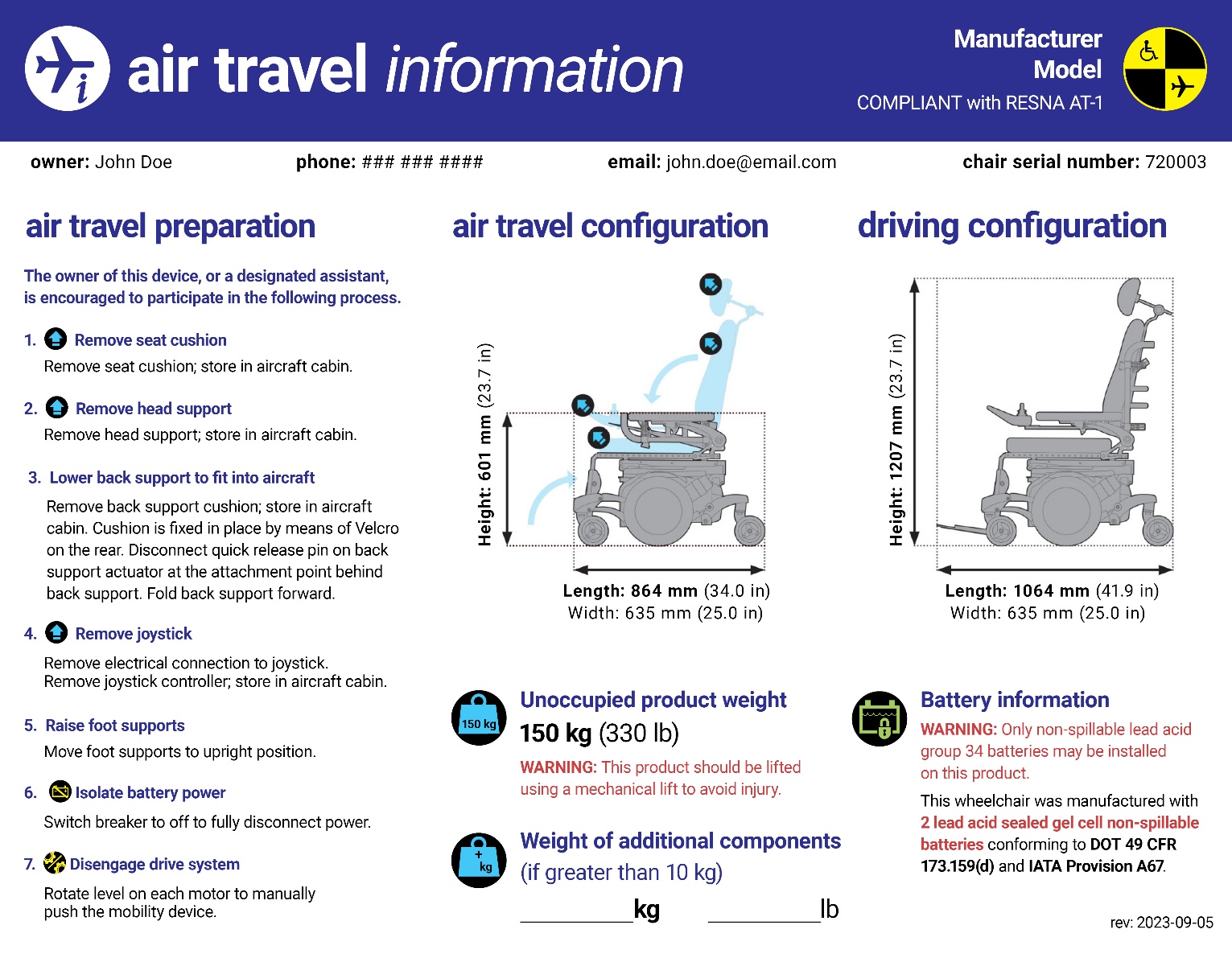
Text description of figure 1
Air travel information
Manufacturer Model
COMPLIANT with RESNA AT-1
Owner: John Doe
Phone:
Email: john.doe@email.com
Chair series number: 720003
Air travel preparation
The owner of this device, or a designated assistant, is encouraged to participate in the following process.
- Remove seat cushion: Remove seat cushion; store in aircraft cabin.
- Remove head support: Remove head support; store in aircraft cabin.
- Lower back support to fit into aircraft: Remove back support cushion; store in aircraft cabin. Cushion is fixed in place by means of Velcro on the rear. Disconnect quick release pin on back support actuator at the attachment point behind back support. Fold back support forward.
- Remove joystick: Remove electrical connection to joystick. Remove joystick controller; store in aircraft cabin.
- Raise foot supports: Move foot supports to upright position.
- Isolate battery power: Switch breaker to off to fully disconnect power.
- Disengage drive system: Rotate level on each motor to manually push the mobility device.
Air travel configuration
- Height: 601 mm (23.7 in)
- Length: 864 mm (34.0 in)
- Width: 635 mm (25.0 in)
Driving configuration
- Height: 1207 mm (47.5 in)
- Length: 1064 mm (41.9 in)
- Width: 635 mm (25.0 in)
Unoccupied product weight
150 kg (330 lb)
Warning: This product should be lifted using a mechanical lift to avoid injury.
Battery information
Warning: Only non-spillable lead acid group 34 batteries may be installed on this product.
This wheelchair was manufactured with 2 lead acid sealed gel cell non-spillable batteries conforming to DOT 49 CFR 173.159(d) and IATA Provision A67.
Weight of additional components
(if greater than 10 kg)
kg
lb
Rev: 2023-09-05
Similarly, IATA provides guidelines for the design of ground handler job aids in their manual on the transportation of mobility aids (IATA, 2023). The guidance was developed by the Mobility Aids Action Group which is composed of airlines, airports, industry associations, disability rights group members, handling agents, mobility aids manufacturers as well as government representatives and research associations (CTA, Transport Canada, and NRC are named contributors). The guidelines emphasize the importance of assisting ground handlers with clear, step-by-step instructions for securing and containing mobility aids in a cargo hold. Instructions should be concise, written in plain language, and primarily rely on visuals to ensure quick and effective reference for ground handlers operating in time-sensitive environments.
Research and design methodology
The mixed-methods project was developed over two phases and completed in 32 weeks. In the first phase researchers conducted semi-structured interviews with 21 SMEs, including 2 mobility aid air travel experts (who designed the RESNA air travel configuration card), 2 wheelchair Original Equipment Manufacturer (OEM) professionals, 13 airport and airline managers, supervisors and directors, and 4 mobility aid advocates who are themselves mobility aid users. Each SME was invited to a 60-minute online interview to share insights on the procedures and challenges associated with transporting mobility aids by air. Additionally, researchers conducted an on-site workflow observation of 5 ground handlers from one airline at an international airport. While participating in the observation, ground handlers were asked a series of questions that provided context for their management of mobility aids. Thematic coding was used to analyse data collected from the interviews, and observations and findings informed the initial design of the job aid system prototype (Table 1).
| Phase | No. | Kind | Recruited | Method |
|---|---|---|---|---|
| 1 | 2 | SME | Mobility aid air travel experts | Semi-structured interview |
| 1 | 2 | SME | Wheelchair OEM professionals | Semi-structured interview |
| 1 | 13 | SME | Airport and airline personnel | Semi-structured interview |
| 1 | 4 | SME | Mobility aid advocates | Semi-structured interview |
| 1 | 5 | Participant | Ground handlers | On-site workflow observation |
| 2 | 8 | Participant | Ground handlers | On-site prototype evaluation |
| 2 | 6 | Participant | Check-in agents | On-site prototype evaluation |
| 2 | 2 | SME | Mobility aid air travel experts | Prototype evaluation interview |
| 2 | 3 | SME | Mobility aid advocates | Prototype evaluation interview |
In the second phase, researchers observed how the prototyped job aid system functioned across the check-in and ground handling operations of two airlines at the same international airport. A second cohort of 8 ground handlers (3 of who participated in the workflow observation) plus 6 check-in agents were recruited as participants and asked to evaluate the effectiveness of the prototype in a staged scenario. Additionally, 5 SMEs (2 mobility aid transportation experts and 3 mobility aid advocates from the original group) were also consulted in follow-up interviews to review the prototype, ensuring that multiple stakeholder viewpoints were captured. These evaluations and interviews were analysed using thematic coding, and findings contributed to a revised job aid system that is ready for integration into airline mobility aid operations as well as employee training programs and resources.
Discussions with subject matter experts
Vital information for handling
Findings underscore the importance of information when handling mobility aids. As one SME said, “When it comes to mobility aids, any spot I would assume would be the best part to hold turns out to be wrong about 50% of the time.” Another said, “Weight distribution becomes a huge challenge, so that's why we expect to have information beforehand.” Furthermore, mobility aids have different specifications and customizations. The complexity of the powered mobility aid is directly proportional to the disability of the user and a lack of clear instructions on how to handle the device often leads to damage during transport.
SMEs identified the following information as vital for successful handling:
- Device weight and dimensions
- Battery type and isolation
- Strapping points for transportation
- Removable parts and foldable parts
- Break disengagement
- Lifting points
- Fragile parts
- Smallest configuration
Standardization of procedures
Ground handlers face challenges when securing mobility aids for transit. As one SME pointed out, “Mobility aids were never designed to be strapped into an aircraft, and an aircraft was never designed to have a mobility aid in the cargo hold.” There is a fundamental design misalignment here worth noting, one that highlights the difficulty of transporting mobility aids.
Ground handlers can develop operational confidence with standard procedures. As one supervisor stated, “Standardization is really the best, the biggest win.” Another SME stated, “Standardizing helps ground handlers see the same information in the same way each time.” Findings also suggest OEMs are considering standardization in the development of mobility aids. One OEM professional said, “We’re going to look at the RESNA standard and abide by that as guidance on how to design for baggage handling.”
Timely and useful information
Ground handlers have a demanding work environment that limits their access to information while performing tasks. As one ground handler supervisor noted, “They only have 35 to 45 minutes to do their job,” emphasizing the time-sensitive nature of their tasks. To compound this, ground handling is physically demanding and often conducted outdoors in poor weather, and constraints such as regional regulations and economics as well as company policies may limit the use of technologies that could channel information.
Experience was also identified as a challenge. One training manager said, “Many ground handlers have zero experience beforehand. Many are part-time hires who meet minimum requirements.” This lack of prior experience shows the importance of simplifying information. Symbols, labels, and the communication of operating procedures need to be consistent and easy to understand. One airline director emphasized a visual approach, stating, “Pictures. 100% pictures. Like, no words. Honestly, anything to do with language isn't going to work.”
Knowledge and training
Handling mobility aids can be a challenge due to the wide variety of models, brands, and customizations. Devices can become highly complex and difficult to handle, as one SME stated, “When something major happens, it's because employees feel they know what they are doing, but they actually don't.” An SME said, “Most of the training happens on the job,” and another explained, “When it comes to mobility aids, it's kind of a dartboard. Training for the ground handler is lagging.” A powered mobility aid advocate further emphasized the need for updated training by commenting, “Powered mobility aids constantly keep changing, so the training on this should happen every year.” The development of training was discussed specifically with one SME reporting, “We are in the process of rolling out annual training for mobility aids.” Another said that training for ground handlers occurred every three years but indicated a shift toward more frequent and standardized education on the handling of mobility aids.
With regards to the kinds of training needed, one SME said ground handlers require both emotional and technical knowledge. Empathy is important to understand the emotional significance of a mobility aid to its user. Findings suggest ground handlers are already trained to recognize that a mobility aid is not just a device but an extension of the body. As one SME explained, “I think ground handlers are already well-versed in the most important thing: that this is somebody's legs, their freedom and independence. They are aware of that.”
Technical training is equally as important. One SME linked the experience of handling an unknown mobility device to being “a new parent frustrated that they can't close the baby stroller.” Without proper technical understanding ground handlers will be at a disadvantage when they are tasked with moving and securing mobility aids.
Observing ground handler operations
Ground handlers at the selected international airport were observed to better understand the procedures and challenges associated with loading powered mobility aids onto a containerized and a non-containerized aircraft. According to ground handlers, the time needed to load an aircraft varies depending on the type of aircraft, airport infrastructure, and environmental conditions. The procedures for loading a mobility aid also depend on the type of aircraft.
Loading wide-body aircraft
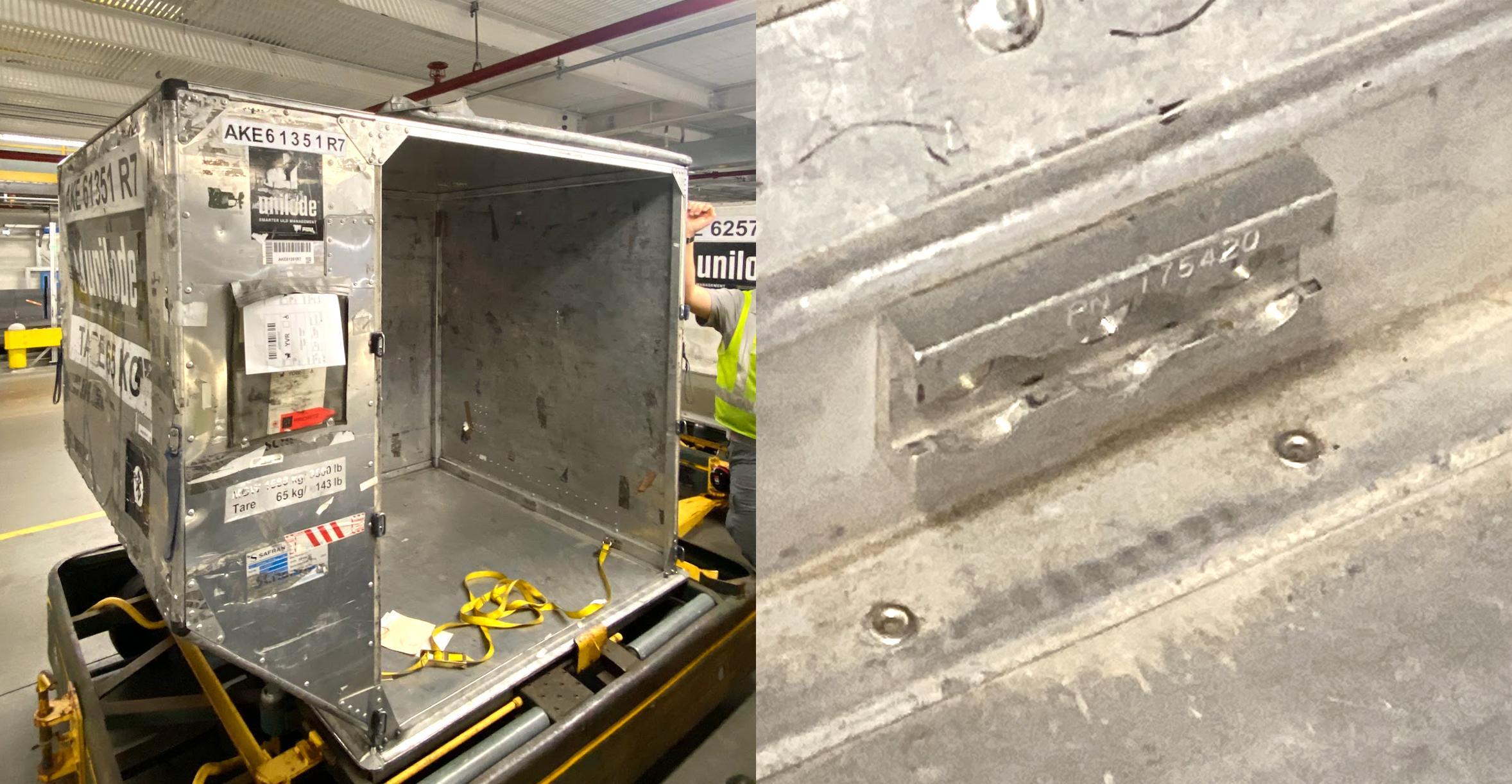
Wide body aircraft use unit load devices (ULDs), commonly referred to as containers. A specialized mobility aid transfer cart is used to load and unload a mobility aid from the container. A single container is used to load one mobility aid and containers with mobility aids are typically loaded last to enable them to be offloaded first upon arrival (Figure 2). According to ground handlers, the information sheet added to the exterior of the container may or may not have additional information related to the mobility aid.
Although researchers did not have a mobility aid during observations, ground handlers discussed how they load a device. Once the mobility aid is loaded into a container, they secure the straps to anchor points along the edge of the floor of the container, pass the straps through or over the main body of the mobility aid, and secure the straps on the other side of the container floor. Due to the unique design of each mobility aid, ground handlers must use their best judgement to identify where best to apply the straps.
Loading narrow-body aircraft
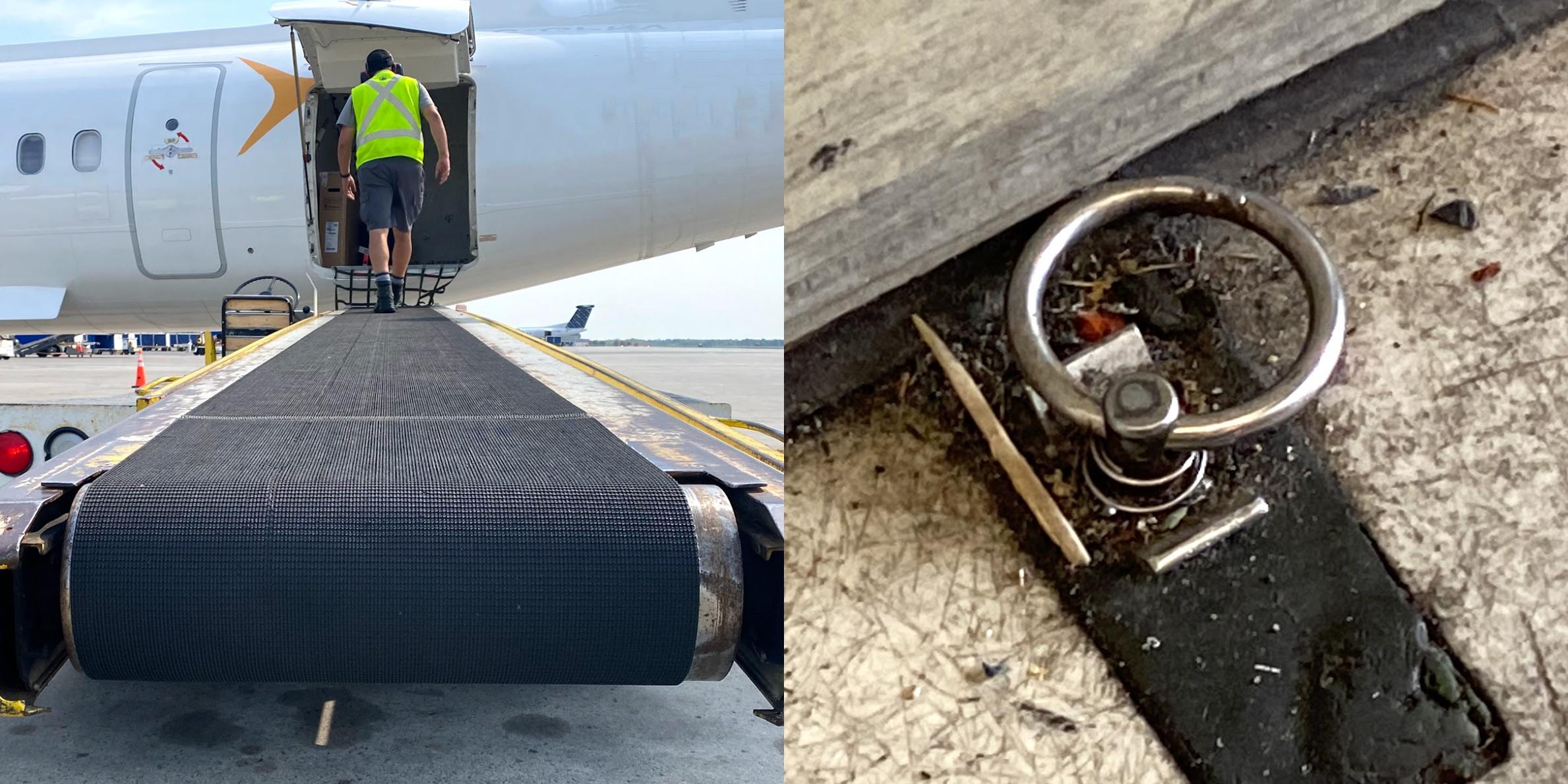
Smaller aircraft rely on belt loaders to stow the mobility aid directly inside the cargo hold. As per discussions with ground handlers, the use of belt loaders is more labor intensive and may increase the risk of damage due to the narrow size of the belt loader and small dimension of the cargo hold door (Figure 3). These restrictions are made more difficult due to the weight of mobility aids. Ground handlers move mobility aids from the aircraft boarding gate to the apron via an elevator near the jet bridge if available. If an elevator is unavailable, ground handlers push the device back to the terminal and through the airport using service elevators.
Once inside the cargo hold, ground handlers position the mobility aid for transport. Once positioned, they run straps through and over the main body of the mobility aid and secure them to anchor points on the floor, similar to how they secure a mobility aid in a container.
Prototyping a job aid system
After a review of the RESNA and IATA guidelines as well as an analysis of SME discussions and ground handler operations, a job aid system was prototyped. The goal of the job aid system is to provide ground handlers and other airport personnel with a standard procedure for handling mobility devices and accessing critical information related to each unique mobility aid.
Requirements based on findings
Requirements were established to align the design of the job aid system with key findings and to ensure ground handlers have the information they need to handle the different kinds of mobility aids they may encounter (Table 2).
| No. | Requirement | Rationale |
|---|---|---|
| 1 | Identify the various mechanical components of a powered mobility aid. | Clear identification of essential details such as batteries, brakes, and removable parts is necessary to prevent mishandling and damage. |
| 2 | Establish a clear transfer of information between multiple parties. | Mobility aids change hands multiple times during travel. For multiple handlers this standardized documentation ensures that crucial handling instructions are consistently communicated across all handovers. |
| 3 | Use an analog medium for the transformation of information. | Given the fast-paced and physically demanding nature of ground handling, where workers are often unable to interact with digital devices, a combination of visual symbols, reference materials, and physical paper-based documentation should be used for information transfer. |
| 4 | Provide knowledge and training for mobility aid handlers. | Training programs must focus on both human and technical skills. |
| 5 | Be sensitive to time constraints. | The system needs to be quick and easy to use, minimizing disruption to ground handling workflows. |
| 6 | Consider hazardous work environments. | Given that baggage handling occurs in challenging conditions, such as extreme weather and low visibility, the job aid needs to be durable and clearly legible. |
| 7 | Support universal adoption. | The system must be applicable across various airlines, aircraft types, and airport environments, ensuring consistency in mobility aid handling. |
Integration of the job aid into air travel systems
These requirements framed the design of a three-part job aid system that can provide ground handlers, check-in agents and other airport personnel a standard procedure for handling mobility aids (Figure 4).
Job aid sticker
The job aid sticker sheet features standardized, easily recognizable symbols that can provide essential information about the mobility aid. The symbols, adopted from the RESNA guidelines for air travel configuration cards, communicate critical information, such as weight, battery type, and designated lifting points. These stickers are applied by check-in agents in conversation with the mobility aid user at the check-in desk at the airport.
Job aid card
Ground handlers can reference the job aid card to get information related to the stickers that have been applied to the mobility aid at the check-in desk. The iconography on the card matches the stickers applied to the mobility aid and provides ground handlers instructions on how to move and secure the device while working in a high-pressure, time-sensitive environment. The job aid card can be worn at the end of a lanyard or in an identification armband.
Job aid poster
The job aid poster provides ground handlers more detailed information on the sticker and card system. The poster can be strategically placed in lunchrooms, common areas, and baggage handling zones to familiarize ground handlers and airport personnel with the stickers they may encounter on a mobility aid to learn best practices for handling.
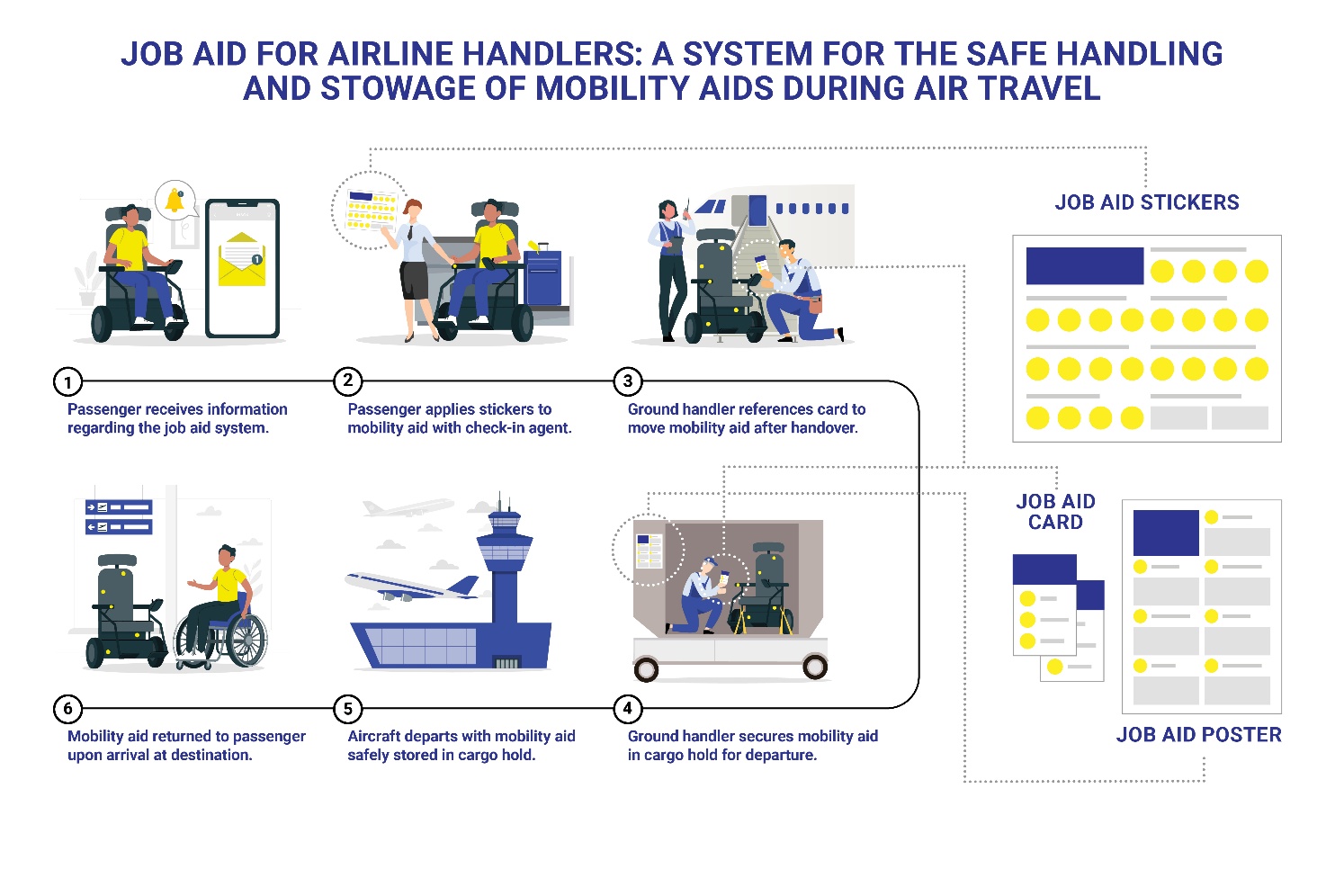
Text description of figure 4
Job aid for airline handlers: A system for the safe handling and stowage of mobility aids during air travel
- Passenger receives information regarding the job aid system.
- Passenger applies stickers to mobility aid with check-in agent.
- Ground handler references card to move mobility aid after handover.
- Ground handler secures mobility aid in cargo hold for departure.
- Aircraft departs with mobility aid safely stored in cargo hold.
- Mobility aid returned to passenger upon arrival at destination.
- Job aid stickers
- Job aid card
- Job aid poster
Evaluating the job aid system
Ground handlers and check-in agents from two airlines were recruited to test the efficacy of the job aid system. To create a real-world scenario, researchers rented a mobility aid and tested the prototype at an international airport. At the end of the evaluation, several mobility aid transportation experts and advocates were invited to a second interview and asked to provide their feedback on the proposed design. Findings from the evaluation provided valuable insight that was used to revise the prototype design.
Feedback from check-in agents
The initial reaction from check-in agents after using the job aid stickers was positive, stating, “The idea is 100% good.” This sentiment was reinforced by another who remarked, “I think it's great. It's straightforward.” By following the instructions on the sticker sheet, check-in agents were able to identify and label critical areas of the mobility aid (Figure 5).
When asked to critique the stickers, check-in agents highlighted their effectiveness in identifying critical parts of a mobility aid. They appreciated the size, visibility, and clarity of the stickers, with comments such as, “The size of the stickers is fine,” and “Icons on the sticker sheet are good,” and “I love that it's yellow.” Others noted that, “All the stickers are understood” and emphasized their bright and visible colours.
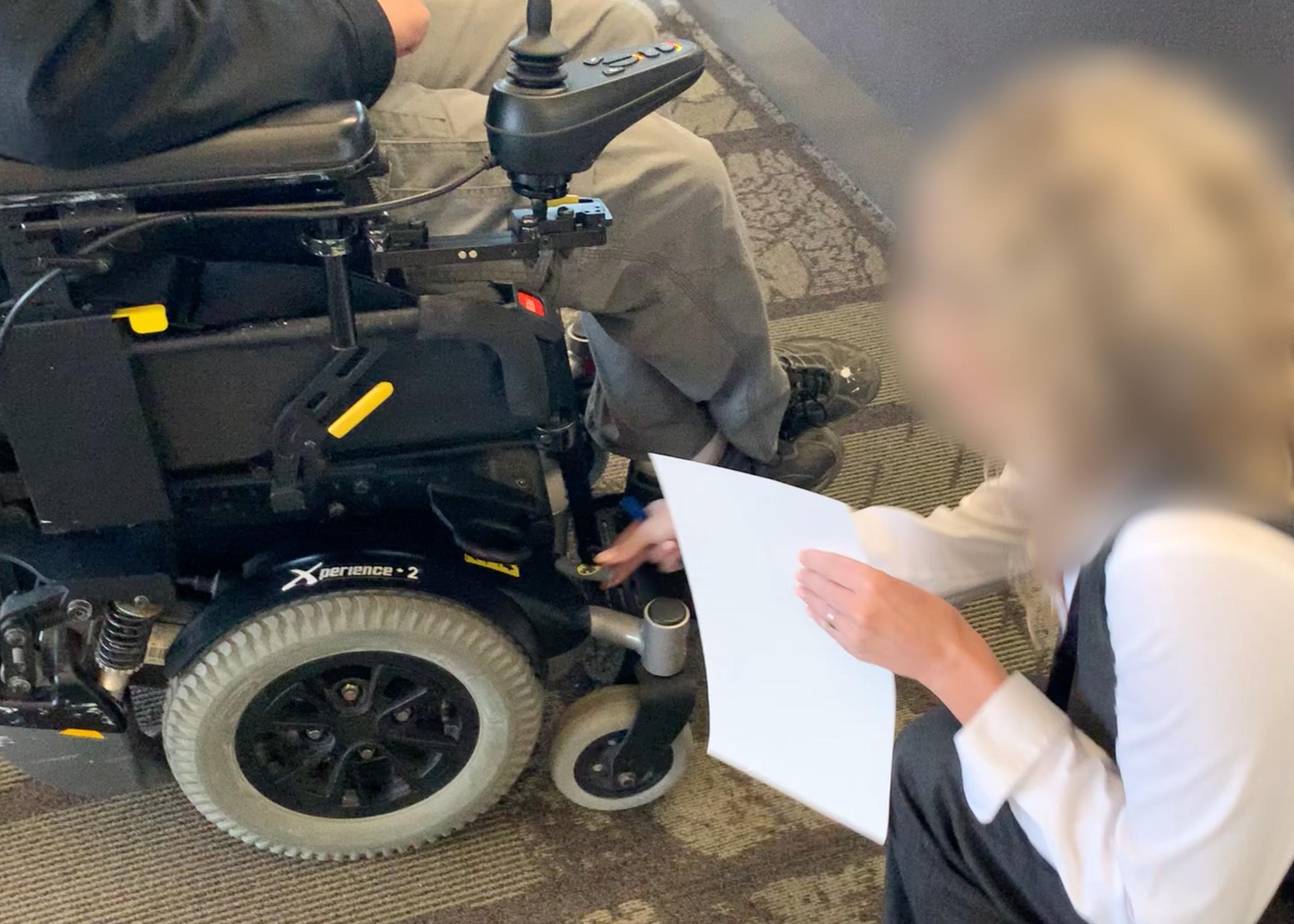
Additionally, multiple check-in agents said they have a procedure for onboarding passengers with mobility aids and ask many of the same questions that are found on the sticker sheet. One agent confirmed this alignment, stating, “Yes, I think we'll use the sticker system because we actually ask these questions anyway at the check-in desk.”
One check-in agent did express concern, stating, “No, I wouldn't be comfortable putting stickers on a powered mobility aid if the user wasn't telling me exactly where to put those stickers. Because if I apply that sticker and something happens to their chair, then that would be on me.” The expressed concern suggests the need for training to reinforce the check-in agent’s role as a facilitator rather than the primary decision-maker in labelling mobility aids.
Another observation was that not all necessary information could be effectively communicated through the job aid symbols alone. In such cases, check-in agents instinctively began writing additional notes directly on the sticker sheet to capture specific details about the mobility aid. The prototype did not include a designated section for custom notes which became a noticeable limitation. Since every mobility aid is unique, the ability to add personalized handling instructions may be valuable.
Implications of check-in agent findings
Table 3 summarizes key findings from the evaluation of the job aid system with check-in agents and implications on future design iteration.
| No. | Findings | Remarks | Implications |
|---|---|---|---|
| 1 | Stickers and instructions communicate effectively. | “The idea is 100% good.” “I think it's great, it's straightforward.” |
Indicates that the visual design and instructions make the sticker system viable. |
| 2 | Design aligns with existing procedures. | “Yes, I think we’ll use the sticker system because we actually ask these questions anyway.” | Reinforces that the sticker system fits naturally into existing check‑in protocols. |
| 3 | Iconography communicates effectively. | “The size of the stickers is fine.” “Icons on the sticker sheet are good.” “I love that it’s yellow.” “All the stickers are understood.” |
Suggests that high visibility, intuitive symbols and minimal text are well‑suited for check‑in tasks. |
| 4 | Uncertainty about who should place the stickers. | “No, I wouldn't be comfortable putting stickers on a powered mobility aid if the user wasn't telling me exactly where to put those stickers. Because if I apply that sticker and something happens to their chair, then that would be on me.” | Highlights need for clear guidelines and training on how (and whether) to apply stickers without placing undue responsibility on the agent. |
| 5 | Uncertainty about how to capture unique instructions. | Researchers observed check‑in agents writing additional instructions on the sticker sheet. | Highlights the need for a blank sticker that can be used to capture instructions unique to the mobility aid. |
Feedback from ground handlers
Ground handlers reported that the job aid system provided a structured approach to identifying critical information about mobility aids. Initial observations revealed ground handlers faced significant challenges in understanding how to properly handle mobility aids. When examining the powered mobility aids, ground handlers struggled with brake disengagement, highlighting gaps in their training and the need for additional support. Once the job aid system was introduced, ground handlers were able to quickly identify essential components and gain a better understanding of device functionality (Figure 6).
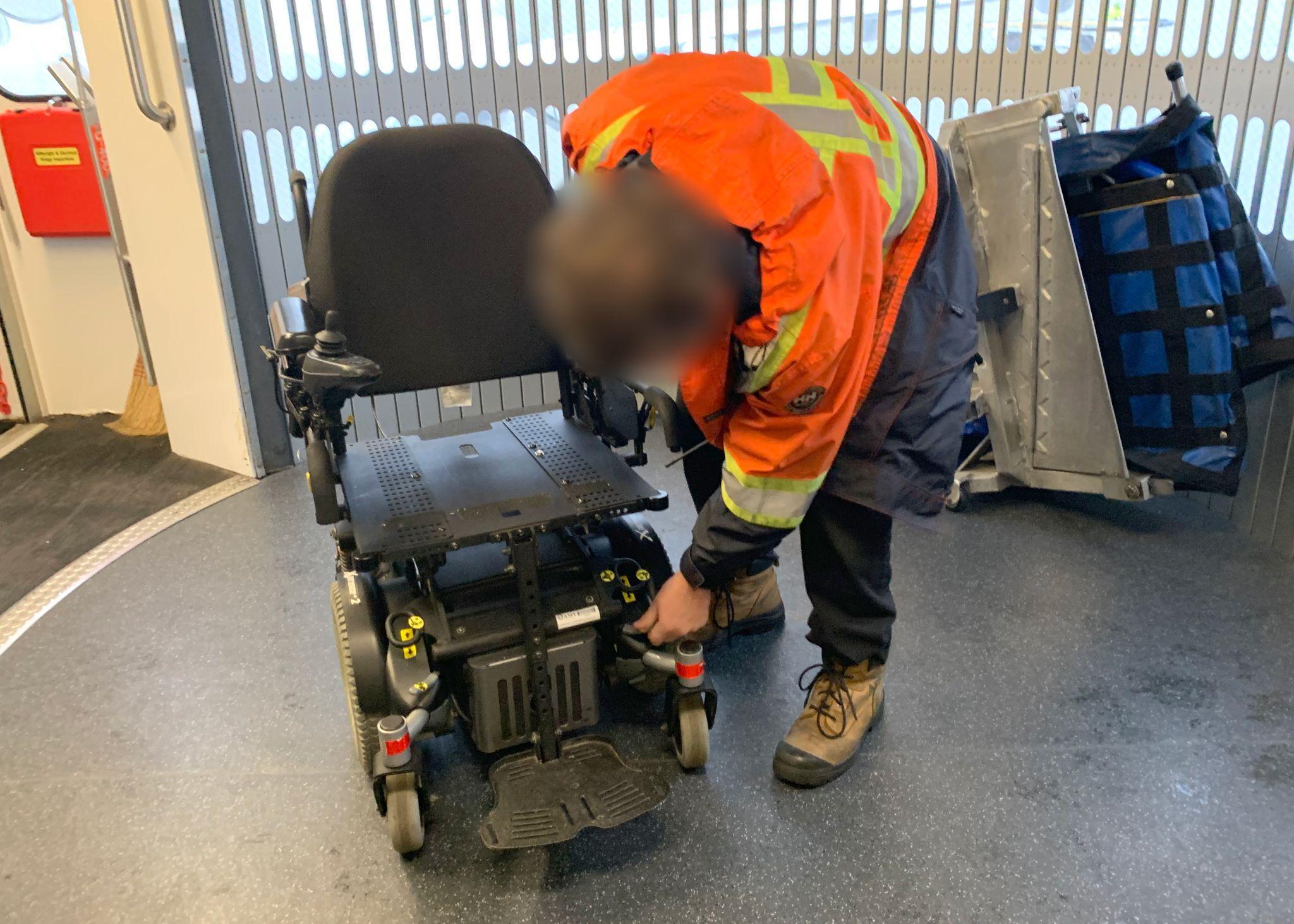
The effectiveness of the stickers and the card was observed in the jet bridge during hand-off between the passenger and the ground handler. Here, the ground handler started looking at the stickers on the powered mobility aid and quickly understood what to do. One ground handler said, “I found the job aid useful when we received the chair on the bridge because it speeds things up. We can identify the parts right away.”
Researchers observed some ground handlers relied on prior experience when making handling decisions, rather than referring to the card and stickers. However, in cases where they were uncertain, such as determining the correct lifting points or finding specific strapping points the stickers and card were referenced. After consulting the job aid system, ground handlers were able to understand the meaning of the symbols and apply the correct handling procedures.
The usability of the job aid card in a baggage handling environment was also noted. Given the physically demanding nature of the job, often performed in challenging weather conditions and exposed to various external factors, researchers aimed to determine whether the cards would be practical for long-term use. Observations suggest that carrying the job aid reference card would not pose a significant challenge for ground handlers as many already use lanyards and arm bands to hold identification and instructional cards.
Implications of ground handler findings
Table 4 summarizes key findings from the evaluation of the job aid system with ground handlers and implications on future design iteration.
| No. | Findings | Remarks | Implications |
|---|---|---|---|
| 1 | Card and sticker system provides a structured approach and faster identification of key components. | “I found the job aid useful. We can identify the parts right away with the sticker labels on the powered mobility aid.” | Demonstrates how labelling and icons improve clarity on lifting points, brakes, and other essential features. |
| 2 | Card provides a quick reference in uncertain situations. | Researchers noted that ground handlers who referred to the card were able to quickly learn how to handle the mobility aid. | Suggests that standardization and concise symbols help address knowledge gaps in real time. |
| 3 | Card integrates into existing processes and workflows. | Researchers noted handlers already carry lanyards and arm bands, making reference cards readily accessible. | Suggests the job aid card can be embedded into existing workflows. |
| 4 | Physical and environmental constraints need | Researchers observed that tasks can occur in challenging weather conditions and time-pressured settings. | Highlights the importance of durability, clear visibility, and minimal text, ensuring the materials are quickly readable. |
| 5 | Ground handlers occasionally relied on intuition rather than the job aid system. | Researchers observed that many handlers defaulted to prior experience instead of consulting the new system. | Suggests further training may be needed to develop a habit of regularly consulting the job aid rather than sporadically using it only when in doubt. |
Feedback from subject matter experts
Discussions with mobility aid advocates were primarily focused on the sticker sheet. Feedback was positive with one SME expressing that they liked the concept and another who said, “They’re actually very well detailed and well done.” However, one SME was unsure whether all the colours should be yellow and black. They suggested that red is typically used to signify the importance of danger and the fragile nature of their mobility aid.
A recurring concern was related to inconsistencies in check-in agent procedures, which one mobility aid advocate described by saying, “There's just a lot of inconsistency so I would just want to be assured that the individual I am talking to with these stickers, that we’re on the same page.”
One mobility aid advocate recommended check-in agents inform the user on the purpose and benefits of these stickers to avoid confusion at the check-in desk. They said, “I think the passenger needs to be well-versed in what to expect at check-in and what will happen once land.” A significant accessibility concern raised by another advocate was the need for a system that supports individuals with communication impairments, saying, “I was thinking of individuals I know who may be completely cognizant but have a very strong speech impediment. They might not be able to articulate.”
Mobility aid advocates expressed concerns about applying stickers to their own mobility aid. One said, “The first thing that came into my mind was that maybe people don't want to use the stickers.” When asked if they would be willing to put a sticker on their chair, an SME initially stated, “No, I would not.” However, after further reflection they said, “As long as it does not damage the chair.” Another advocate stated, “I love my chair. As long as the stickers are removable, great. But obviously, if they're going to be removable, they've got to go through getting on and off the aircraft.”
Mobility aid air travel experts were also consulted. Their review of the job aid system was favourable, stating the design was in alignment with the RESNA AT-1 standard and would provide an interim solution while OEMs adopt the air travel configuration card and labels. Moreover, the job aid system would be valuable if mobility aid users choose not to use the air travel configuration card and labels provided by OEMs.
Implications of SME findings
Table 5 summarizes key findings from the evaluation of the job aid system with SMEs and implications on future design iteration.
| No. | Findings | Remarks | Implication |
|---|---|---|---|
| 1 | Value in developing clear and consistent training. | “I would just want to be assured that the individual I am talking to with these stickers, that we’re on the same page.” | Emphasizes the need for standardized procedures across staff, ensuring uniform application of stickers and training on handling protocols. |
| 2 | Passengers need to be informed about the job aid system. | “I think the passenger needs to be educated on the design system if this is what’s going to happen at check-in and what will happen once they land.” | Highlights pre-travel communication to reduce confusion, particularly for first-time travellers with mobility aids. |
| 3 | Need support for users with communication impairments. | “I was thinking of individuals I know who may be completely cognizant but have a very strong speech impediment. They might not be able to articulate.” | Suggests the need for alternative communication methods or simplified, visual instructions that accommodate varied abilities. |
| 4 | Overall reaction to concept and design was positive. | “They’re actually very detailed and well done.” | Suggests the stickers communicate effectively. |
| 5 | Consider the reluctance to place stickers on mobility aids. | “As long as it does not damage the chair.” “They still need to be strong enough. They’ve got to go through getting on and off the aircraft.” |
Indicates concerns about potential damage to devices and underscores the need for removable and non-residue adhesives. |
| 6 | Need to accommodate different sticker colours and formats. | Researchers consider whether all stickers remain uniform in colour or diversified for warnings. | Highlights a potential design iteration to differentiate critical warning labels. |
Finalizing the job aid system
Requirements based on findings
The evaluation of the design aid system with ground handlers and check-in agents and the interviews with SMEs were instrumental in defining requirements for the iteration of the job aid system (Table 6).
| No. | Requirement | Rationale |
|---|---|---|
| 1 | Use removable, non-damaging adhesives so labels can be applied and removed without residue. Provide flexible labeling for passengers preferring fewer permanent marks on their device. |
Some users are worried about residue or damage to their mobility aid if stickers are applied. |
| 2 | Explore weather-resistant materials such as ultraviolet ink and heavy-duty vinyl to handle rain, snow, and sunlight. Explore alternate sticker design for surfaces where flat adhesion is difficult. |
Stickers must endure repeated handling, harsh weather, and rough cargo environments. |
| 3 | Add step-by-step procedures and icon definitions to the card. Develop periodic refresher sessions to ensure staff remember correct securement methods and passenger‑consultation protocols. |
Irregular exposure to powered mobility aids may cause skill fade leading handlers to sometimes guess based on past experience. |
| 4 | Consider passengers who may have a cognitive disability by developing icon‑focused labelling with minimal text. Create multi‑language and visual reference materials to ensure easy communication even when speech or language barriers exist. |
A purely text‑based system may be inaccessible for users with a cognitive or speech impairment. |
| 5 | Consider pre‑check‑in communication such as a website or email from the airline to explain sticker usage before arrival to the airport. Add return‑to‑gate sticker to ensure the device is promptly brought back for passenger use upon arrival. |
Early passenger awareness can minimize confusion and accelerate labelling at the check‑in desk. |
| 6 | Create a dedicated “custom notes” sticker for unique instructions or modifications. Encourages staff to take notes of specific instructions, e.g., detached joystick. |
Icons alone sometimes fail to capture special instructions for complex devices. |
| 7 | Update icons to differentiate removable versus non‑removable batteries and revise power isolation to clarify on/off states. Add fragile and foldable labels to signal delicate parts or items that can be collapsed. |
Avoid confusion about removable versus non‑removable batteries, power isolation switches, or fragile components. |
| 8 | Develop a job aid system that is accessible in both French and English. | Design must be made available in both official languages. |
Final job aid sticker design
The updated job aid sticker design includes new Fragile, Custom Note and Return to Gate labels as well as a redesigned shape of the Removable Parts label (Figure 7).
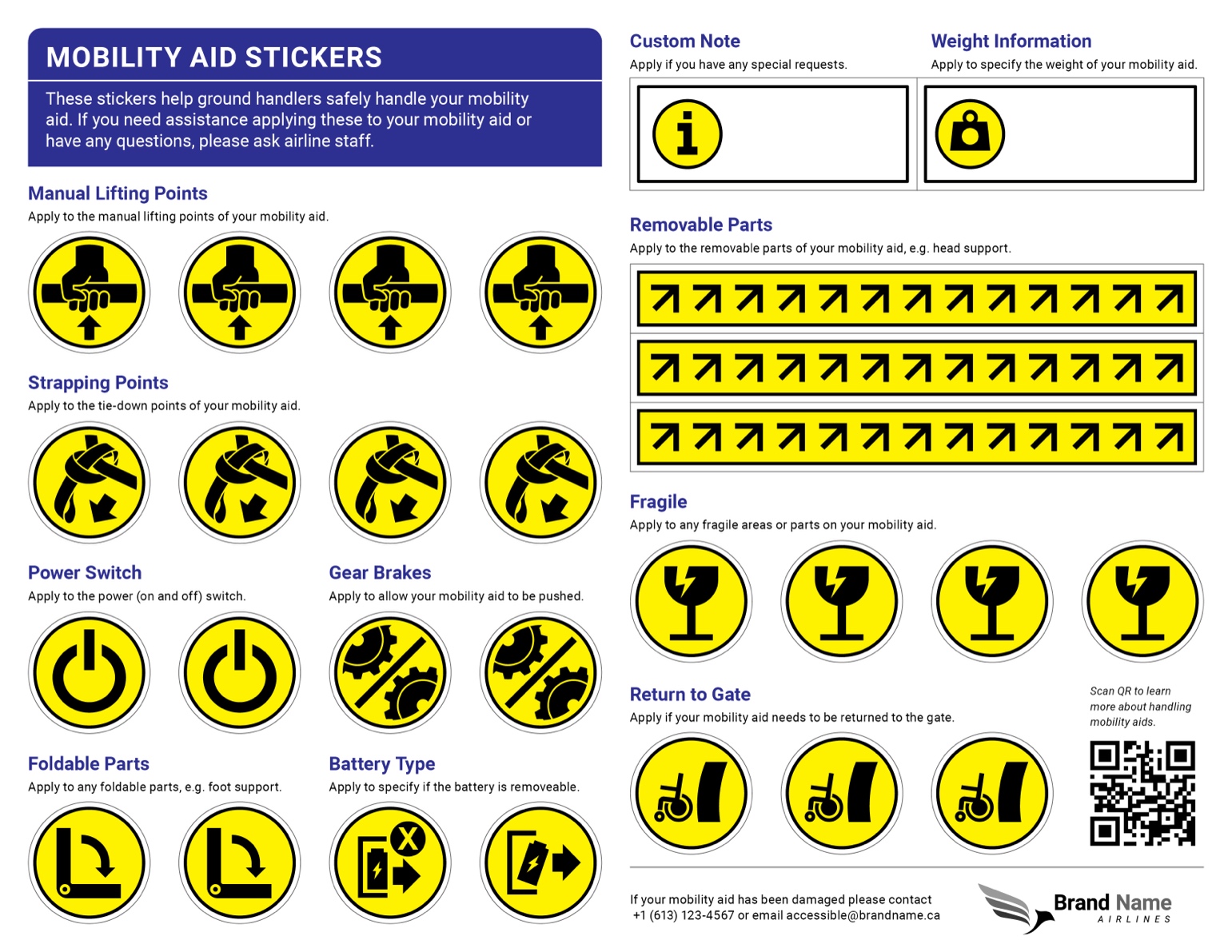
Text description of figure 7
Mobility aid stickers
These stickers help ground handlers safely handle your mobility aid. If you need assistance applying these to your mobility aid or have any questions, please ask airline staff.
- Manual lifting points: Apply to the manual lifting points of your mobility aid.
- Strapping points: Apply to the tie-down points of your mobility aid.
- Power switch: Apply to the power (on and off) switch.
- Gear brakes: Apply to allow your mobility aid to be pushed.
- Foldable parts: Apply to any foldable parts, e.g., foot support.
- Battery type: Apply to specify if the battery is removable.
- Custom note: Apply if you have any special requests.
- Weight information: Apply to specify the weight of your mobility aid.
- Removable parts: Apply to the removable parts of your mobility aid, e.g., head support.
- Fragile: Apply to any fragile areas or parts on your mobility aid.
- Return to gate: Apply if your mobility aid needs to be returned to the gate.
If your mobility aid has been damaged please contact 613-123‑4567 or email accessible@brandname.ca.
QR code: A scannable code is displayed. Scan QR to learn more about handling mobility aids.
Brand Name Airlines (logo with stylized wing)
Final job aid card design
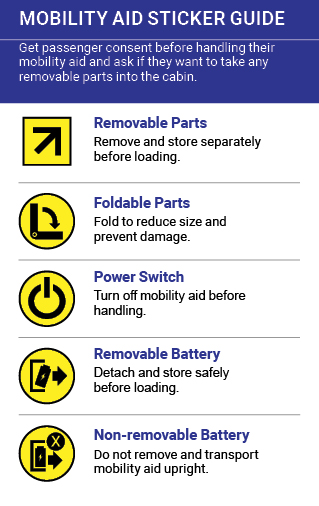
The job aid card was updated to include reference to the revised labels. Instructions were added to remind ground handlers to consult with mobility aid users (Figure 8).
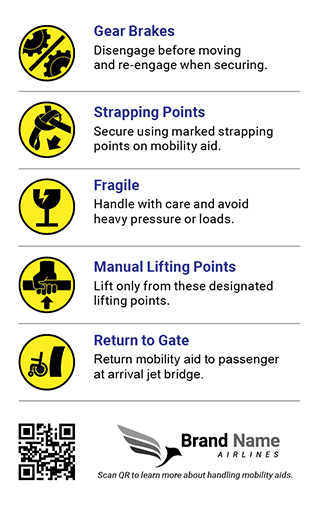
Text description of figure 8
Mobility aid sticker guide
Get passenger consent before handling their mobility aid and ask if the passenger want to take any removable parts into the cabin.
- Removable parts: Remove and store separately before loading.
- Foldable parts: Fold to reduce size and prevent damage.
- Power switch: Turn off mobility aid before handling.
- Removable battery: Detach and store safely before loading.
- Non-removable battery: Do not remove and transport mobility aid upright.
- Gear brakes: Disengage before moving and re-engage when securing.
- Strapping points: Secure using marked strapping points on mobility aid.
- Fragile: Handle with care and avoid heavy pressure or loads.
- Manual lifting points: Lift only from these designated lifting points.
- Return to gate: Return mobility aid to passenger at arrival jet bridge.
QR code: A scannable code is displayed. Scan QR to learn more about handling mobility aids.
Brand Name Airlines (logo with stylized wing)
Final job aid poster design
Lastly, the job aid poster was updated with the revised labels and edited to include related information and instructions (Figure 9).
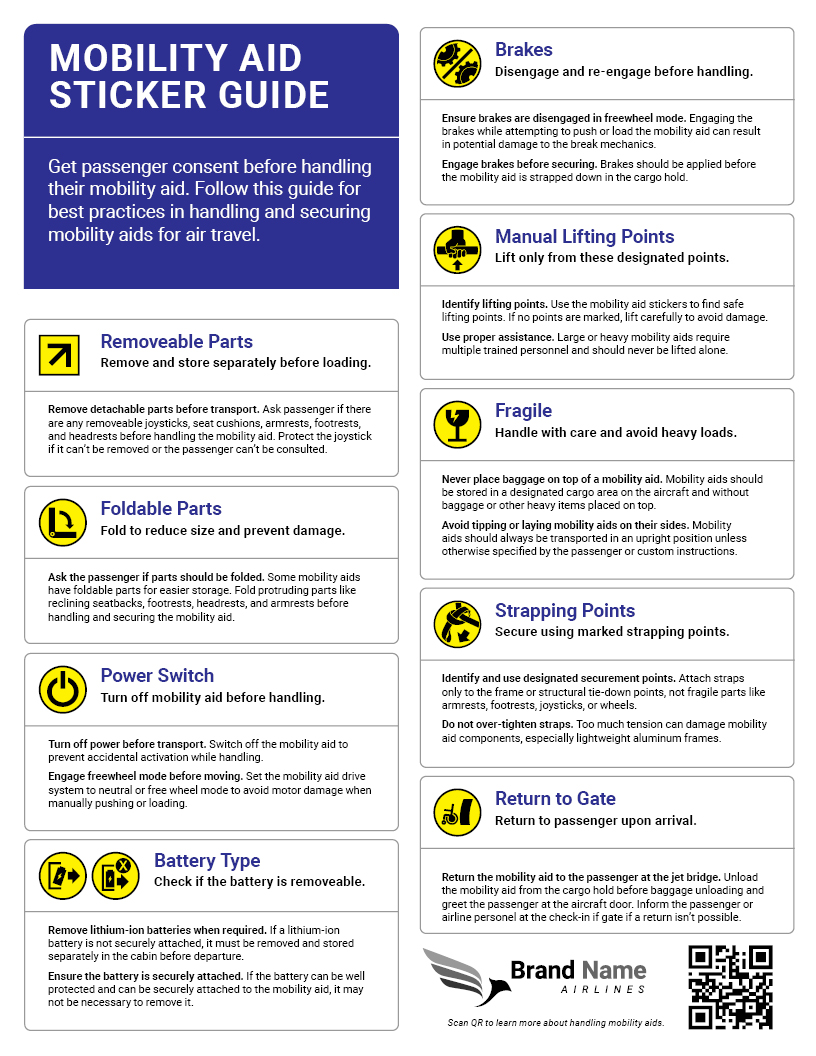
Text description of figure 9
Mobility aid sticker guide
Get passenger consent before handling their mobility aid. Follow this guide for best practices in handling and securing mobility aids for air travel.
- Strapping points: Secure using marked strapping points. Identify and use designated securement points. Attach straps only to the frame or structural tie-down points, not fragile parts like armrests, footrests, joysticks, or wheels. Do not over-tighten straps. Too much tension can damage mobility aid components, especially lightweight aluminum frames.
- Manual lifting points: Lift only from these designated points. Identify lifting points. Use the mobility aid stickers to find safe lifting points. If no points are marked, lift carefully to avoid damage. Use proper assistance. Large or heavy mobility aids require multiple trained personnel and should never be lifted alone.
- Power switch: Turn off mobility aid before handling. Switch off the mobility aid to prevent accidental activation while handling. Engage freewheel mode before moving to avoid motor damage when manually pushing or loading.
- Brakes: Disengage and re-engage before handling. Ensure brakes are disengaged in freewheel mode. Engaging the brakes while attempting to push or load the mobility aid can result in damage. Brakes should be applied before the mobility aid is strapped down in the cargo hold.
- Foldable parts: Fold to reduce size and prevent damage. Ask the passenger if parts should be folded. Fold protruding parts like reclining seatbacks, footrests, headrests, and armrests before handling and securing the mobility aid.
- Removable parts: Remove and store separately before loading. Ask the passenger if there are any removable joysticks, seat cushions, armrests, footrests, and headrests. Protect the joystick if it can’t be removed or the passenger can’t be consulted.
- Battery type: Check if the battery is removable. Remove lithium-ion batteries when required. If not securely attached, they must be removed and stored separately in the cabin. If securely attached and well protected, removal may not be necessary.
- Fragile: Handle with care and avoid heavy loads. Never place baggage on top of a mobility aid. Store in a designated cargo area without heavy items. Transport upright unless otherwise specified by the passenger or custom instructions.
- Return to gate: Return to passenger upon arrival. Unload the mobility aid from the cargo hold before baggage unloading and greet the passenger at the aircraft door. Inform the passenger or airline personnel at check-in if a return isn’t possible.
QR code: A scannable code is displayed. Scan QR to learn more about handling mobility aids.
Brand Name Airlines (logo with stylized wing)
Support for both official languages
The job aid system was designed to support both official languages in Canada and has the flexibility to support additional languages (Figure 10).
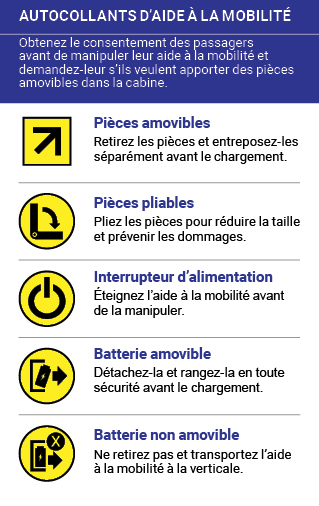
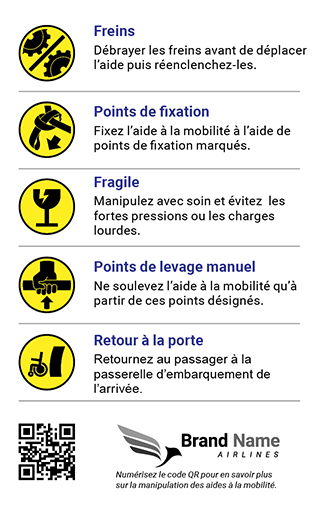
Text description of figure 10
Autocollants d’aide à la mobilité
Obtenez le consentement des passagers avant de manipuler leur aide à la mobilité et demandez-leur s’ils veulent apporter des pièces amovibles dans la cabine.
- Pièces amovibles: Retirez les pièces et entreposez-les séparément avant le chargement.
- Pièces pliables: Pliez les pièces pour réduire la taille et prévenir les dommages.
- Interrupteur d’alimentation: Éteignez l’aide à la mobilité avant de la manipuler.
- Batterie amovible: Détachez-la et rangez-la en toute sécurité avant le chargement.
- Batterie non amovible: Ne retirez pas et transportez l’aide à la mobilité à la verticale.
- Freins: Débrayer les freins avant de déplacer l’aide puis réenclenchez-les.
- Points de fixation: Fixez l’aide à la mobilité à l’aide de points de fixation marqués.
- Fragile: Manipulez avec soin et évitez les fortes pressions ou les charges lourdes.
- Points de levage manuel: Ne soulevez l’aide à la mobilité qu’à partir de ces points désignés.
- Retour à la porte: Retournez au passager à la passerelle d’embarquement de l’arrivée.
Code QR : Un code scannable est affiché. Numérisez le code QR pour en savoir plus sur la manipulation des aides à la mobilité.
Brand Name Airlines (logo avec aile stylisée)
Selecting the right materials
The selection of materials to be used in the production of the job aid system was informed by research findings. Key factors included durability, visibility, and ease of application and removal.
Job aid stickers
Stickers need to adhere to various surfaces such as cloth, metal, carbon fibre, plastic, and rubber while remaining removable without losing adhesive integrity. Vinyl stickers with ultraviolet ink and medium-strength adhesives are recommended. Stickers should be selected based on how well they perform in outdoor environments and respond to changes in temperature.
Job aid card
It is recommended cards are produced using a synthetic or plastic material that is both waterproof and thick enough to endure rough working conditions. A hole punch at the top or bottom will allow ground handlers to attach the card to a lanyard or insert it into an armband for quick access, ensuring that critical information is always within reach.
Job aid poster
The poster can be printed on durable cardstock with a protective varnish to enhance its durability when placed in high-traffic areas around the airport.
Cost of materials
Researchers contacted several print shops to estimate the cost of producing the job aid system. Table 7 represents a price range in CAD based on the average of three separate quotes.
| No. | Design | Dimensions | Material | CAD Estimate |
|---|---|---|---|---|
| 1 | Stickers | 8.5” x 11” | Vinyl material with UV-ink and medium-strength adhesive. | ~ $15,890 for 10,000 units or $1.59 per sheet. |
| 2 | Card | 2.125” x 3.375” | Synthetic material or plastic. | ~ $1,699 for 10,000 units or $0.17 per sheet. |
| 3 | Poster | 8.5” x 11” | Cardstock with a protective varnish. | ~ $8,166 for 10,000 units or $0.82 per sheet. |
Integrating the job aid system into training
Ground handlers and check-in agents do not interact with powered mobility aid devices on a regular basis. The infrequency of interaction may result in skill fade which can be defined as a gradual loss of knowledge over time. The job aid system has the potential for addressing the gradual loss of knowledge by providing ground handlers, check-in agents and airport personnel a visual guide with information on how to move and secure mobility aids. However, researchers recommend the job aid system be embedded in current and future training to ensure critical mobility aid handling procedures remain clear.
Requirements based on findings
Researchers recommend future ground handling, check-in agent and airline personnel training reference these key requirements that have been amalgamated from all findings (Table 8).
| No. | Requirement | Remarks | Rationale |
|---|---|---|---|
| 1 | Develop structured, formal training modules to supplement on‑the‑job learning. Ensure consistent updates and inclusion of universal standards so training aligns with changing device features and IATA/RESNA guidelines. |
“Most of the training happens on the job for ground handlers.” “When it comes to mobility aids it’s kind of a dartboard. Training for ground handlers is lagging.” |
Reliance on ad‑hoc or infrequent training leads to ground handlers sometimes operating with outdated procedures or insufficient information. |
| 2 | Provide hands‑on demos for brake disengagement, power isolation, and strapping points. Include guided practice using the new sticker system for more accurate securement. |
“When something major happens, it’s because employees feel they know what they are doing, but they actually don’t.” | Gaps in technical knowledge can lead to confusion about the mechanics and securement of mobility aids. |
| 3 | Schedule frequent refreshers to address new mobility aid features. Maintain a feedback loop where handlers can report novel device quirks. |
“Powered mobility aids constantly keep changing, so the training on this should happen every year.” | Rapidly evolving mobility aid technology and changing designs require ongoing training updates to remain current. |
| 4 | Combine technical training with empathy‑based scenarios (e.g., viewing the mobility aid as an extension of the user). Reinforce the emotional importance of safe handling throughout all training modules. |
“I think handlers are already well‑versed in the most important thing: the fact that this is somebody’s legs.” | Emphasizing empathy and human‑centered insight can lead to emotional awareness that pairs with robust technical knowledge. |
| 5 | Emphasize visual‑based training such as icons and diagrams in workshops and reference guides. Reinforce standardized steps so all handlers, regardless of language or background, follow consistent procedures. |
“100% pictures, like no words. Honestly, anything to do with language isn’t going to work.” “Standardization is really the best, the biggest win.” |
Visual communication and standardization of procedures can reinforce use of the job aid system. |
| 6 | Need for reinforcing the role of the check‑in agent as a facilitator instead of a decision‑maker. | “No, I wouldn’t be comfortable putting stickers on a powered mobility aid if the user wasn’t telling me where to put them. Because if I put that sticker and if something happens, then that would be on me.” | Highlights need for clear guidelines and training on how (and whether) to apply stickers without placing undue responsibility on the agent. Suggests airlines should clarify agent responsibilities, ensuring the process respects passenger preferences and safety. |
| 7 | Gaps in technical training on mobility aid mechanics were identified. | “There’s just a lot of inconsistency with procedures.” Researchers observed that handlers struggled with key aspects such as movement and brake disengagement, highlighting training gaps that require additional support. |
Reinforces the need for targeted training modules or follow‑up coaching on unique device features. |
| 8 | Ground handlers occasionally relied on intuition rather than the job aid system. | Researchers observed that many handlers defaulted to prior experience instead of consulting the prototype. | Suggests further training may be needed to develop a habit of regularly consulting the job aid system. |
Future application
Researchers proposed a job aid system that supports the safe handling and transportation of mobility aids by ground handlers, check-in agents and other airline personnel. The design meets IATA/RESNA guidelines, the requirements defined by discussions with various SMEs and the observation of ground handling operations at an international airport. As a next step, researchers recommend the job aid system be piloted with an airline by introducing the prototype into ground handler and check-in agent standard operating procedures and training.
Below are additional recommendations to be considered before implementation of the job aid system by airlines, international standards guidelines or federal agencies:
- Test the durability of adhesives in different outdoor environments: Canadian and international airports experience a range of weather conditions that can affect stickers.
- Conduct a quantitative assessment of the job aid system: Use workplace and workflow measurement tools to audit the effectiveness of the job aid system in the piloting phase.
- Develop training for ground handlers and check-in agents: While standard operating procedures exist, hands-on training of the mobility aid system is recommended.
- Create passenger awareness before check-in: Implementing a pre-check-in communication protocol will help users understand the job aid system.
- Design a website: The development of a web portal with a comprehensive overview of the job aid system will be valuable to airline personnel and mobility aid users.
- Conduct a cost analysis at scale: An evaluation of the costs required to launch and maintain the job aid system across all airlines in Canada will be required.
References
- Canadian Transportation Agency. (2022, March 14). Accessible transportation for persons with disabilities regulations. CTA. https://otc-cta.gc.ca/eng/accessible-transportation-persons-disabilities-regulations
- Bamford, A. (2023, November 9). Air Canada apologizes, introduces new measures amid growing accessibility Issues. CTV News. https://www.ctvnews.ca/canada/air-canada-apologizes-introduces-new-measures-amid-growing-accessibility-concerns-1.6638977
- Department of Justice Canada. (2019, May 24). Accessible Transportation for Persons with Disabilities Regulations. Justice Laws Website. https://laws-lois.justice.gc.ca/eng/regulations/SOR-2019-244/index.html
- Ghoussoub, M. (2023, November 8). Hundreds of travellers with disabilities report injuries, damaged wheelchairs while flying. CBC News. https://www.cbc.ca/news/canada/british-columbia/travellers-with-disabilities-report-injuries-while-flying-1.7021094
- Hunter-Zaworski, K.M. (2019, May 29). Mobility Aids and Air Travel Final Report. Canadian Transportation Agency, Centre of Expertise for Accessible Transportation. https://otc-cta.gc.ca/eng/publication/mobility-aids-and-air-travel-final-report
- International Air Transport Association. (2023, February). Guidance on the Transport of Mobility Aids. IATA. https://www.iata.org/contentassets/7b3762815ac44a10b83ccf5560c1b308/iata-guidance-on-the-transport-of-mobility-aids-final-feb2023.pdf (PDF)
- International Air Transport Association. (2025, January 1). Battery-Powered Wheelchairs and Mobility Aids Guidance Document. IATA. https://www.iata.org/contentassets/6fea26dd84d24b26a7a1fd5788561d6e/mobility-aid-guidance-document.pdf (PDF)
- Paleske, C., Kelsey, S., & Ziccardi, A. (2022). Safe Securement and Containment of Mobility Aids in the Cargo Compartment (Phase 2). National Research Council Canada/Conseil national de recherches Canada.
- Rehabilitation Engineering and Assistive Technology Society of North America. (2021, September). AT-1 Section 4: Labelling and Design Requirements for Mobility Devices Designed for Stowage and Transport in Commercial Aircraft. RESNA. https://www.resna.org/Portals/0/AT_AT-1_Section%204_SellSheet_9_30_21.pdf (PDF)
- Date modified: