
 Listen to text
 MP3
MP3Annual Report 2024–2025
Table of contents

Message from the Chair and CEO:
Continually making improvements to better serve Canadians


The last few years have been eventful for the Canadian Transportation Agency (the Agency), and in particular as it relates to air passenger protection. In June 2023, following a series of major flight disruptions, consumer dissatisfaction, and a significant increase in the number of air passenger complaints being submitted to the Agency, Parliament made changes to the Canada Transportation Act (the Act). The goal was to modify how the Agency processes air passenger complaints, to strengthen the Canadian air passenger protection regime, and to require the agency to recover its costs for processing air passenger complaints.
The Agency’s implementation began immediately following the passing of the legislation with the second half of 2023 being dedicated to build and launch brand new processes and functions in the organization – namely the Air Travel Complaints Resolution Office (ATCRO), which was launched on September 30, 2023. The Agency is proud to report that in 2024-25, it has closed more than 33,000 complaints in its first full fiscal year of operations. This is a significant increase compared to 11,158 in 2022-23 under the previous resolution model. However, over the last three years, more than 40,000 complaints per year were received, hitting a record high of over 46,000 in 2024-25, and as of March 31, 2025, there are 84,398 complaints waiting to be processed. The Agency takes its backlog of complaints seriously. It will continue to utilize resources responsibly to maintain its complaints processing capacity while ensuring quality and consistency. To this end, the Agency is exploring how it can leverage tools such as artificial intelligence to further improve outcomes for Canadians.
Additionally, after consulting with the Minister of Transport, the Agency published proposed amendments to the Air Passenger Protection Regulations (APPR) regulations for consultations in Canada Gazette Part I, in December 2024. The Agency also undertook a consultation on the recovery of costs associated with the processing of air passenger complaints. Input received through these consultation processes will be taken into consideration as the Agency determines how to move these initiatives forward in the year ahead.
With respect to its responsibility to support an efficient national transportation system, the Agency, continued to actively engage with railways and shippers. These interactions are essential for Agency analysts to maintain their knowledge and expertise in the sector. The “rail team” has now, for the third year, implemented its rail monitoring program, which includes analysis of the performance of the sector based upon a set of standardized performance metrics. This ensures that all stakeholders have the same performance information and serves as a base for the team in facilitating the informal resolution of issues amongst the various parties.
The Agency also began its five-year review of the Railway Interswitching Regulations. The Agency launched consultations on November 21, 2024. Submissions will be reviewed and stakeholder input will be considered in the annual rate determination, which will contribute to setting rates that are fair and reasonable to all parties and ensure that shippers also have fair and reasonable access to services from more than one railway, thereby promoting greater competition within the system.
Accessible transportation remained a priority for the Agency which over the last year, has laid the groundwork for several important initiatives, both domestically and internationally. For example, the Agency continues to collaborate closely with transportation service providers to support improved training on transportation of mobility aids. Internationally, the Agency continues to play a leadership role in the ongoing work of advancing accessibility at ICAO, reinforced during 2024/25 ICAO Year of Facilitation. A key project which the Agency supported actively was the development of a comprehensive strategy for international aviation accessibility. Accessibility complaints have substantially increased last year and the Agency is developing and implementing a plan to improve its efficiency and processing capacity.
As the Agency continues to focus on improving services to Canadians in all key areas of its responsibility, I am grateful to be able to count on a highly competent cadre of public service employees and appointed Members. As an organization, the Agency continues to seek stability in its resources and ensures its workforce continues to be competent, diverse and firmly rooted in the principles of Values and Ethics.
In 2025, the Agency was named one of the top employers in the National Capital Region for the second consecutive year. This special designation recognizes employers in the Ottawa-Gatineau area that are leaders in providing exceptional places to work. This is in part due to our achievements during the year. For example, the Agency made investments in attracting and retaining a highly skilled workforce by promoting a culture of innovation and by enhancing its talent management practices. The Agency has also worked to provide a safe, inclusive, and accessible working environment enabling all employees to play a part in the Agency’s success and to achieve their full potential.
I am proud of the Agency’s achievements and recognize that none of these would have been possible without the hard work, expertise, and integrity of Agency employees. Our positive work environment is a direct result of their involvement. Canadians can be assured that they are totally committed and dedicated to provide them with the high level of service they deserve.
France Pégeot
The context of the Agency's work
The transportation sector is critical to the success of the Canadian economy and serves as the backbone of domestic and international trade. Although the sector recovered from several notable disruptions throughout the 2024-2025 fiscal year, those events accentuated the importance of innovative solutions and continued investments to maintain resiliency in the transportation sector.
Labour unrest throughout the rail industry led to significant delays and backlogs throughout the network. In August 2024, a shutdown of the freight railway operations of Canadian National Railway Company (CN) and Canadian Pacific Kansas City Limited (CPKC) disrupted freight and passenger rail services across the country, leading to delays and service reductions. Additionally, shutdowns at the Port of Vancouver led to supply chain disruptions and shipment delays. Labour unrest also impacted the air industry – WestJet cancelled flights impacting nearly 6,500 travellers in anticipation of a possible strike by its aircraft mechanics in June 2024.
Climate-related challenges have impacted both the rail and air sectors. In particular, record flooding and extreme cold weather disrupted the fluidity of rail line movements, while droughts and extreme weather conditions affected grain crop and other agricultural commodity yields. With respect to the air sector, severe thunderstorms and snowstorms led to flight groundings, delays, and airport closures at Canada’s major international airports. Despite the challenges of 2024, both the rail and aviation sectors demonstrated resilience in their recoveries and are expected to enter 2025 with more robust contingency plans in place. Airlines have adjusted route networks to accommodate demand shifts and mitigate the ongoing pilot shortage. Specifically, they have increased the number of long-haul flights and usage of larger aircraft, reduced regional service offerings, and changed fee structures, such as the introduction of basic fare options that no longer include carry-on baggage.
Flight delays and cancellations remained a significant issue, and in 2024, the Agency received a record-breaking number of air travel complaints. Accordingly, it remains committed to maximizing the use of its resources. This work involved continuing to look for efficiencies and optimize processes, while at the same time ensuring that the Agency maintains a high level of quality and consistency in its work.
There was also a decrease in the presence of ultra-low-cost-carriers (ULCCs), highlighted by the bankruptcies of Lynx Airlines in February 2024 and of Canada Jetlines in August 2024, leading to less market competition in the air sector. Subsequently, the House of Commons Standing Committee on Transport, Infrastructure and Communities (TRAN) launched two studies one on the state of airline competition in Canada, and another on the Competition Act and air travel in northern, rural, and remote communities of Canada. Additionally, the Competition Bureau Canada launched a market study of competition in passenger air travel service in Canada in May 2024, with a specific focus on domestic air passenger services. It also examined how governments across Canada can improve competition for the benefit of domestic air passengers and the workers and entrepreneurs who enable these services.
Accessibility in the air sector remained a key area of interest throughout 2024-2025. In May 2024, the Government of Canada hosted the first National Air Accessibility Summit, led by the Minister of Transport and the Minister of Diversity, Inclusion and Persons with Disabilities. In December 2024, the House of Commons TRAN committee concluded its study on accessible air transportation in Canada for persons with disabilities. The committee issued a report which included recommendations to address the gaps in the rights of persons with disabilities with respect to air travel and improve their travel experience. On the international stage, the International Civil Aviation Organization (ICAO) designated 2024 as the Year of Facilitation, resulting in accessibility becoming a priority for the organization. Canada has continued its leadership in shaping international best practices for inclusive air travel, supporting the country’s commitment to ensuring a barrier-free transportation system by 2040.
An efficient transportation system for Canada
One of the primary responsibilities of the Agency is to support an efficient transportation system for Canada. The Canada Transportation Act (the Act) includes the National Transportation Policy, which guides the Agency. It states that competition and market forces are the prime agents in providing viable and effective transportation services and that regulation may be used to achieve economic, safety, security, environmental or social outcomes that cannot be achieved by competition and market forces alone.
Rail
The Agency was founded in 1904 as a railway regulator. This role continues to be essential in contributing to the efficient operation of an industry that moves over $380 billion in goods each year.
The Agency:
- Monitors freight rail performance in Canada;
- Issues certificates of fitness for federal railway companies and enforces compliance with minimum insurance requirements;
- Determines railway costs, approves rail line construction, oversees the discontinuance of service, establishes the net salvage value of railway lines;
- Determines interswitching rates and the maximum revenue entitlement for the movement of Western grain; and,
- Resolves disputes between railway companies and shippers over rates or levels of service, and between individuals or communities affected by rail noise and vibration or relating to railway crossings.
The Agency’s rail industry business line engages with stakeholders at various levels, reflecting the Agency’s focus on engagement as a core strategic priority over the past several years. These efforts support the efficiency of the rail transportation system and help fulfill the Agency’s legislative responsibilities. Stakeholder collaboration is multifaceted, and regular contact with railways ensures that the data they provide, which is essential to meeting the Agency’s statutory obligations, are accurate and verified.
Regular meetings with railway stakeholders provide a forum to discuss supply chain conditions, commodity movement, operational challenges, and shippers’ concerns. The Agency also engages directly with shippers to better understand their specific market conditions, the level of service they receive, and the challenges they encounter. In addition, the Agency has successfully facilitated productive and increased dialogues between shippers and railways. Through these dialogues, potential solutions to improve system performance can be identified. This comprehensive engagement ensures the Agency maintains a balanced view of the rail transportation system from both railway and shipper perspectives.
By addressing critical issues in key locations, the Agency ensures that the rail transportation system remains responsive to user needs and effectively addresses emerging challenges. This comprehensive approach to stakeholder engagement supports the Agency in maintaining a robust and adaptive rail monitoring program, thereby enhancing the overall health and efficiency of Canada's transportation system.
Monitoring freight rail service performance
The Agency monitors rail performance and service issues various data provided by railway companies and shippers. This information helps evaluate the overall health of the transportation system, broadly assessing service timeliness, and identifying evolving service disruptions.
As part of this monitoring program, the Agency examines grain volumes and movement to assess how well rail services meet the Grain Handling and Transportation System's (GHTS) requirements. If service levels hinder the effective functioning of the GHTS, further investigation may be conducted to determine if the issues fall within railway control.
The Agency also monitors embargo data to ensure embargoes implemented by railways are appropriate—specifically, targeted, used sparingly, and only as a last resort. Embargo data helps pinpoint the specific causes and impacts of service disruptions and identifies commercial practices inconsistent with railway obligations to the transportation system and its users.
Using this data and leveraging increased rail stakeholder engagement, the Agency monitors system disruptions and collaborates with railways and shippers to enhance efficiency and recovery. This proactive approach enables Agency staff to quickly identify supply chain issues and engage stakeholders effectively for improved communication and resolution. Additionally, the Agency has expanded its outreach related to system monitoring by increasing regularly scheduled informal meetings with key rail stakeholders, including CN, CPKC, and shipper associations, to address rail service issues that may not be apparent from the monitored data.
This multifaceted approach has enhanced information sharing, improved response times to disruptions, and facilitated timely analyses of the rail system, contributing to faster recovery when issues arise.
Implementing legislative requirements for Western grain movement and interswitching
Since its founding in 1904, the Agency has been seized with issues regarding the transportation of Western grain to market. The Act has legislated annual requirements for the Agency to make determinations that support this activity.
The Maximum Revenue Entitlement (MRE) determination is a form of economic regulation that allows CN and CPKC to set their own service rates, provided that total revenues collected from shipments of Western grain remain below the ceiling established by the Agency. This year's determination (R-2024-190) found that CN’s revenues were below its maximum grain revenue entitlement, while CPKC’s revenues exceeded its respective entitlement for the 2023–2024 crop year. Regulations require any revenue collected above the entitlement, plus a five percent penalty, to be paid to the Western Grains Research Foundation. Accordingly, CPKC was required to pay penalties totaling $1,915,287.
See Table 1: Maximum revenue entitlements provides additional details from the MRE determination.
The Agency also determines the Volume-Related Composite Price Index (VRCPI) each crop year. The VRCPI is an inflation factor applied during MRE determinations, reflecting a composite of forecasted prices for railway labour, fuel, materials, and capital purchases. The Agency’s determination involves reviewing and verifying data supplied by railway companies. In 2024, the VRCPI determination (R-2024-63) identified increases of 5.39% for CN and 6.49% for CPKC over the previous crop year, primarily due to updates from forecasted 2023 price changes to actual price changes and incorporating revised forecasts for 2024. A subsequent determination (R-2024-124), adjusted CN’s VRCPI upwards to account for costs incurred in acquiring hopper cars for regulated grain movements in Western Canada.
Interswitching is the mandatory transfer of traffic between two railway companies under regulated rates, in order to increase the options available to a shipper that would normally only have access to one railway. This transfer is typically required within 30 kilometres of an interchange.
Through the Budget Implementation Act, 2023, the Government of Canada amended the Act to enable a temporary 18-month pilot extending the interswitching distance in the Prairie Provinces to 160 kilometres. In support of this pilot, which ended in March 2025, the Agency determined the 2025 rates for the new interswitching zone (R-2024-181).
On November 21, 2024, the Agency launched consultations to fulfill the legislative requirement to review the Railway Interswitching Regulations every five years. The Agency invited stakeholders to share their views to ensure that the Railway Interswitching Regulations (SOR-88-41) are clear, and the rates methodology is fair and reasonable to all parties.
The Agency prepared an interswitching review paper that focused on the following key issues:
- Eligible traffic; and,
- Factors in setting the interswitching rate.
The Agency anticipates consultations to conclude in late April, 2025, and implementation of any potential changes (if required) to the Railway Interswitching Regulations to occur in late 2025, or early 2026.
Approving railway construction applications
The Agency plays a role in assessing railway construction applications under section 98 of the Act, considering both the requirements for railway operations and services, and the interests of the localities affected by the railway line. It reviews applications to evaluate land use compatibility, noise and vibration concerns, environmental impact, community consultation efforts, and other relevant factors related to the proposed location of the railway line.
These projects can play an important role in augmenting supply chain capacity, reducing congestion, optimizing freight movement, and strengthening Canada’s trade corridors. The Agency remains committed to having an efficient review process which supports infrastructure development while addressing community concerns, ensuring that railway expansion is carried out responsibly and sustainably through transparent decision-making and stakeholder engagement. Over the coming year, the Agency will perform a full review of this approval process to identify opportunities for streamlining.
In approving the construction of railways under Section 98 of the Act, the Agency is constitutionally required to ensure that the rights, interests, and perspectives of Indigenous peoples are fully considered in the decision-making process. As a result, it has developed a document, How to Apply for Approval to Construct a Railway Line: Indigenous Consultation and Engagement Guide – DRAFT (Guide), to inform how this obligation will be met. The Agency is currently engaging with Indigenous groups to gather their feedback in order to improve the guide and will also consult with railway companies in the near future.
Providing clarity on certificates of fitness and compliance monitoring requirements
The Agency issues a Certificate of Fitness (CoF) to a company proposing to construct or operate a railway under federal jurisdiction once it has demonstrated that it holds the required third-party liability insurance. This insurance must cover the risks outlined in the Act and regulations. For freight rail operations, the minimum coverage is determined based on reported traffic volumes of crude oil and dangerous goods. For passenger rail, the company must secure adequate insurance specific to its operations. The Agency monitors compliance by engaging with CoF holders, issuing notices to industry outlining Agency standards and expectations, and conducting annual reviews of the third-party liability insurance requirements set out in the Act.
In 2024, the Agency introduced a monitoring process for third-party liability insurance requirements for approved railway construction projects. This process increases the certainty that both the railway and its contractors maintain valid and adequate insurance coverage throughout construction activities. In 2024, staff confirmed that the insurance coverage for phase II of CN’s construction of the Milton Logistics Park was adequate.
In early 2025, based on research and engagement with passenger rail carriers over the past two years, the Agency began implementing a new risk-based approach to evaluating the adequacy of third-party liability insurance for companies carrying passengers. This initiative will strengthen the Agency’s decision-making process by ensuring its determinations in this area reflect the actual operating conditions of the carriers.
The Agency may vary CoFs to account for changes in railway operations or may cancel or suspend a certificate as necessary. In 2024, Goderich-Exeter Railway Company Limited’s section 32 application to rescind its CoF was found to be non-compliant with the requirements of subsection 88(4) of the Act (9-R-2024). Tshiuetin Rail Transportation Inc. obtained a variance of its CoF to reflect changes in its operations related to the volume of dangerous goods (R-2024-129). Baffinland received a determination from the Agency specifying the conditions that must be met before it can obtain a CoF for the proposed Steensby Railway construction on Baffin Island, Nunavut (R-2024-106). Finally, Capital Railway was granted a variance to its CoF to reflect phase 2 operations of the Trillium line in Ottawa (R-2024-179).
Rail disputes
Rail disputes are complex undertakings that require significant technical, economic, or mediation expertise. In 2024-2025, the Agency resolved 21 rail disputes. Of these, the Agency resolved nine through mediation, 11 through adjudication, and one through arbitration. The Agency also addressed 63 enquiries via its Rail Helpline.
See Complaints and disputes about rail transportation, for more information on the types of complaints the Agency handles. See Table 4: Rail and marine dispute resolution and Statistics 2024–2025 for the Agency's detailed dispute resolution and other statistics.
Air
With respect to the efficiency of air transportation, the Agency is responsible for:
- Issuing licences and charter permits to Canadian and foreign airlines offering services to the public;
- Enforcing all applicable licensing requirements;
- Applying Canadian ownership and financial fitness requirements all domestic airlines;
- Participating in the negotiation and implementation of international air transport agreements as part of the Government of Canada negotiating team; and,
- Ensuring airlines have tariffs (the contract between an airline and its passengers that covers the rights and obligations of both) applicable to their air services that are consistent with the Act.
Efficient air licensing
In 2024-2025, the Agency approved 82 air licence applications, including 53 foreign carrier licence applications, once the Agency was satisfied that they had demonstrated that they met the requirements to hold a licence. There were also 1,082 permits issued for passenger resaleable, passenger non-resaleable, and cargo charters, as well as processed 3,670 charter flight notifications.
See Table 2: Air licensing activities and Statistics 2024–2025 for the Agency's detailed dispute resolution and other statistics.
In addition, the Agency has initiated a project to facilitate the efficient submission by airlines of all licensing related information. The project is centered on the development and deployment of a web-based portal that airlines will use to submit requests for licensing and flight operating authorities. The portal will also be used by airlines to meet their ongoing regulatory filing requirements.
Monitoring the Canadian status of domestic airlines
The Act requires that airlines that hold domestic licences and certain international licences issued by the Agency must be owned and controlled in fact by Canadians. The Agency regularly monitors compliance with the Canadian status requirement.
In May 2024, the Agency confirmed that 2746904 Ontario Inc., carrying on business as Pivot Airlines (Pivot), would continue to be Canadian following the proposed acquisition of Pivot by Pivot Holding Company Canada Inc. (LET-A-26-2024), which included a non-Canadian investor.
International cooperation
The Agency participates in the negotiation and implementation of international air transport agreements. In 2024-2025, the Agency participated in negotiations resulting in five new or amended air transport agreements. The Agency has also continued its work to support the ratification of previously negotiated agreements with Cameroon, Colombia, and the Dominican Republic.
The Agency supports the work of the Canadian mission to the International Civil Aviation Organization (ICAO). In its role as Canada’s representative to the ICAO Facilitation Panel, the Agency, through Canada’s National Facilitation Committee, coordinates Canadian positions on matters related to Annex 9 (Facilitation) to the Chicago Convention, and provides subject matter expertise, as required.
Marine
Coasting Trade
Under the Coasting Trade Act, only Canadian-registered ships can provide marine carriage of goods or passengers between points in Canada unless no Canadian ships are available and suitable for the task in question. The Agency plays a role in the coasting trade licensing process by determining whether suitable Canadian ships are available when someone applies to use foreign ships for domestic commercial marine activities. The Agency provides this determination to the Minister of Public Safety and Emergency Preparedness for further action. Using a foreign ship is only allowed if the Minister issues a coasting trade licence.
In 2024-25, the Agency processed 74 coasting trade applications, marking a 61 percent increase from the previous year. Of the contested applications, 21 were withdrawn by the applicants, and one was denied by the Agency.
See Table 3: Marine Coasting Trade Applications and Table 4: Rail and marine dispute resolution. See Statistics 2024–2025 for the Agency's licencing and other statistics.
Court Decisions
Milton Rail Federal Court of Appeal Ruling
In July 2024, the Federal Court of Appeal issued a decision dismissing an appeal by various public authorities and municipalities (Halton) of the Agency's determination approving the construction of CN's Milton Logistics Hub project under section 98 of the Act. In dismissing the appeal, the Court found that Halton had not demonstrated any error in the Agency's interpretation of section 98 and that the Agency’s reasons were detailed and comprehensive. In particular, the Court found no issue in the manner in which the Agency considered interests of the localities and confirmed the broad discretion given to the Agency to weigh those interests against railway needs.
Consumer protection for air passengers
A core Agency responsibility is to provide consumer protection for air passengers. In its role as a regulator, the Agency ensures that current regulatory framework aligns with developments in the transportation system; as a tribunal, the framework works to provide timely dispute resolution services and access to justice based on procedures that take into account the impact and complexity of the cases. A key component of this responsibility is the implementation of the Air Passenger Protection Regulations (APPR).
Air Passenger Protection Regulations 3.0
The APPR came into force in 2019 and defined an airline’s minimum requirements and obligations, including obligations toward passengers when a flight disruption occurs (delay, cancellation, or when a passenger is bumped/denied boarding). They were created to provide a clear, comprehensive, and consistent set of passenger rights, however, over the past five years, some aspects of the APPR have proven to be overly complex and/or unclear for both airlines and passengers to understand and to implement.
In June 2023, modifications to the Act amended the APPR’s legislative framework to ensure clearer and more consistent passenger rights. Regulatory amendments are required to reflect the legislative changes and address other implementation issues.
In December 2024, after consulting with the Minister of Transport, the proposed amendments to the APPR were pre-published in the Canada Gazette, Part I for public comment. This consultation process was held for a period of 75 days and ended on March 6, 2025. The proposed amendments covered:
- Exceptional circumstances, specified by the regulations, under which an airline would not have to provide compensation for inconvenience to passengers;
- Minimum assistance (food, drink, access to a means of communication, and overnight accommodations) the airline must provide to passengers in the case of all flight disruptions, including in the exceptional circumstances specified by the regulations;
- Ensuring that passengers complete their itinerary within a reasonable time or receive a refund;
- Enhanced communication requirements that are more prescriptive to ensure that passengers receive timely, clear and adequate information;
- Limits for large carriers on the use of knock-on-effects as the reason for flight disruptions due to exceptional circumstances; and,
- A revised definition and criteria for denial of boarding.
Modifications to the Act also require that the draft regulations set out obligations for airlines to provide refunds when a passenger cancels a reservation due to the issuance of a Government of Canada travel advisory.
During the consultation period, the Agency received over 90 submissions from airlines, consumer organizations, passenger advocates, academics, and the general public. The Agency will review the comments received and determine next steps to advance the regulatory amendment process in consultation with the Minister of Transport.
Complaints Resolution Office (CRO): One year later
Record number of closures
Since its launch on September 30, 2023, the Complaints Resolution Office (CRO) has been delivering a more streamlined, efficient, and automated approach to resolving air travel complaints. This transformation has already resulted in significant improvements in productivity, demonstrating the effectiveness of the new process.
Before September 30, 2023, the dispute resolution process for air passenger complaints had three stages that culminated in a court-like adjudication, during which the Governor in Council appointed members of the Agency weighed the evidence and issued a decision. During the first two stages (facilitation and mediation), there were no fixed timelines, and informal dispute resolution was attempted, but the Agency had no power to decide the case. Only Agency members could make a final decision during adjudication.
Under the new CRO process, the decision-makers are Agency public servants – complaints resolution officers – who can deal with the entire complaint process, including rendering a final decision. The process starts with determining a complaint's eligibility based on the legislation's criteria. If the complaint is not eligible, for example, because it is clear that the passenger has not tried to resolve the matter with the airline first, or that complaint is not within the scope of the issues that the Agency can resolve, it proceeds no further. If the complaint is eligible, parties will be provided an optional opportunity to engage in mediation. If declined, a final decision is issued by a Complaint Resolution Officer who can decide whether the airline met its obligations and, if appropriate, order a remedy, such as compensation, a refund or reimbursement for expenses to the complainant.
During 2024-2025, its first full fiscal year, the CRO closed over 33,600 complaints, more than ever before. This represents a 201% increase in comparison to the last full fiscal year preceding the creation of the CRO, when 11,158 cases were closed. This significant increase reflects the continued optimization of digital tools, structured workflows, and automation enhancements.
Figure 1: The number of annual complaints processed by the Agency prior to and after the creation of the CRO.
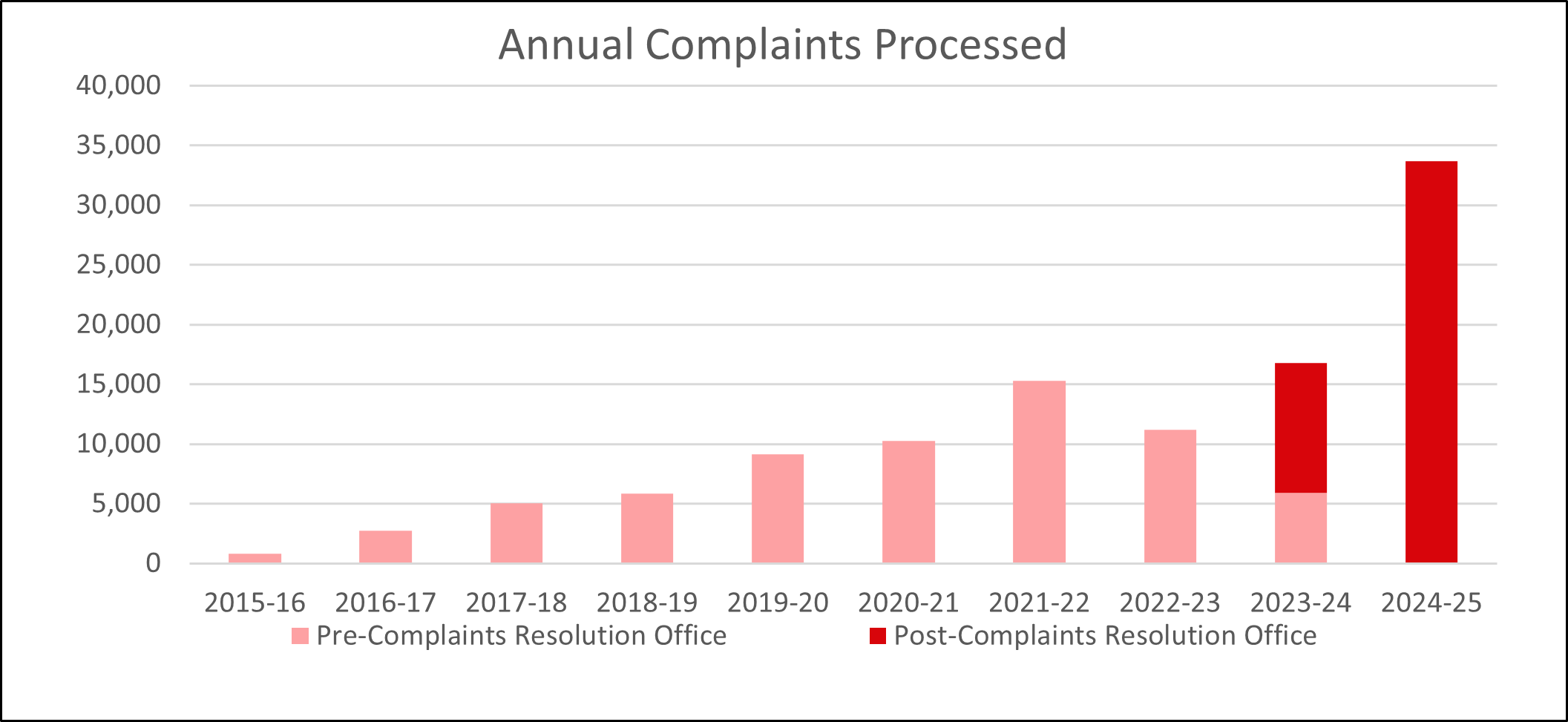
Text alternative for chart of air travel complaints processed prior to the Complaints Resolution Office, and complaints processed post the Complaints Resolution Office.
| Annual complaints processed | 2015 to 2016 | 2016 to 2017 | 2017 to 2018 | 2018 to 2019 | 2019 to 2020 | 2020 to 2021 | 2021 to 2022 | 2022 to 2023 | 2023 to 2024 | 2024 to 2025 |
|---|---|---|---|---|---|---|---|---|---|---|
| Pre-Complaints Resolution Office | 807 | 2,752 | 5,065 | 5,839 | 9,143 | 10,227 | 15,264 | 11,158 | 5,930 | |
| Post-Complaints Resolution Office | 10,829 | 33,691 |
Unfortunately, despite these significant improvements in processing capacity, the Agency continues to receive record levels of incoming complaints annually – exceeding 40,000 for the third consecutive year, which led to 84,398 complaints in backlog as of the end of the 2024-2025 fiscal year. The Agency continues to develop new tools, processes, and strategies to maximize the number of complaints that can be resolved and is currently working to leverage artificial intelligence to aid resolution officers allowing them to render decisions more quickly.
The new CRO model has leveraged a simplified process to ensure that complaints requiring further analysis receive appropriate attention while minimizing administrative delays.
The impact of the CRO is already clear: a more efficient and cost-effective process that is setting new standards for air travel complaint resolution. The Agency will continue to prioritize innovation and operational excellence to better serve the traveling public in 2025 and beyond.
Air travel complaints processing statistics can be found in the following tables:
Table 5: New complaints, backlog and processed
Table 6: Number of complaints per 100 flights operated by Canadian airlines
Table 7: Number of complaints per 100 flights operated by foreign airlines
Table 8: Number of complaints processed (by carrier)
Cost recovery
Consultation results
In June 2023, the Budget Implementation Act, 2023 introduced changes to the Act that would require the Agency to establish fees or charges to recover costs for processing eligible air travel complaints, from airlines, and to consult with the public before establishing the fees or charges. The Agency published a fee proposal, from September 18 to November 4, 2024, to seek feedback from the public, consumer organizations, industry stakeholders, and academics on a fee of $790 for each eligible processed and closed air travel complaint. The Agency received a total of 83 written submissions: 30 from members of the public; 46 from airlines and other industry representatives; six from consumer advocacy organizations; and one from a territorial government.
Court Decisions
Supreme Court of Canada decision on APPR
On October 4, 2024, the Supreme Court of Canada (SCC) released its decision in International Air Transportation Association v. Canada (Transportation Agency). The SCC upheld the Air Passenger Protection Regulations (APPR), which require airlines to provide compensation to passengers in cases of delays, cancellations, denied boarding, or issues with lost or damaged baggage on international flights, and dismissed the appeal.
The challenge to the APPR was brought by a group of airlines and related organizations after the Federal Court of Appeal dismissed their initial challenge in 2022. The central question before the SCC was whether the APPR, which establish standardized passenger compensation, conflicted with the Montreal Convention, an international treaty outlining rules for airline liability.
The SCC clarified that its previous decision in Thibodeau v. Air Canada (2014), which addressed the Montreal Convention’s scope, did not resolve this specific issue. Ultimately, the SCC concluded that Canadian regulations could coexist with international agreements, confirming the validity of the APPR and reinforcing passengers' rights to compensation and airlines' obligations to provide it.
Accessible transportation for Canadians
The Agency plays an essential role in protecting the fundamental right of persons with disabilities to accessible transportation services through resolving disputes as well as developing and implementing regulations.
The Agency actively consults with persons with disabilities, industry stakeholders, and the public. It does so through various means including its Accessibility Advisory Committee (AAC), working groups formed to address specific issues and develop practical solutions, and formal consultation processes during the development of regulations. In addition, the Agency regularly collaborates with its government and international partners.
The Accessible Transportation for Persons with Disabilities Regulations (ATPDR) are, in many regards, world-leading regulations. They establish clear, consistent accessibility requirements for all types of federally regulated transportation. These requirements cover accessible communications, services, equipment and infrastructure, and the provision of training to transportation sector employees. For example, the regulations help ensure:
- Someone in a wheelchair receives proper assistance from the curb to the plane at airports;
- There is enough space for a service dog on a plane;
- Transportation service providers communicate information in formats accessible to travellers with various disabilities; and,
- Personnel are trained to provide effective and appropriate services to persons with disabilities.
The Agency has developed guidance and best practices material to ensure that the ATPDR requirements are as clear as possible for persons with disabilities and the industry.
Accessibility Initiatives
Mobility Aids
The Agency launched and chairs the Canadian Mobility Aid Working Group, which also includes airlines, airports, their respective associations, and representatives of persons with disabilities. The working group collaborates regularly to address issues related to the carriage of mobility aids.
The working group is generating ideas for voluntary initiatives to better enable and optimize the carriage of mobility aids; exchange information about best practices; and be a forum to discuss work that is being done internationally on this issue. The group is supporting an initiative on the development of a job aid for mobility aids handlers, by providing access to airport and carrier facilities, and by participating in the testing of the job aids.
The working group is also supporting the research carried on by the University Health Network (UHN), affiliated with the University of Toronto, regarding the development of the technical guidelines for mobility aid storage. Funded by Accessibility Standards Canada to investigate the causes of damage to mobility aids during air travel, the goal is to develop technical guidelines and training materials for the securement of mobility aids in cargo holds, and will be supported by laboratory simulations and data collection.
Job aids for mobility handlers
The National Research Council Canada (NRCC), in partnership with the Agency and Transport Canada, has developed job aids for mobility aid handlers, consisting of visual aids to help handlers quickly recall their training during operations.
Two NRCC deliverables, one on job aids and the other on providing stickers to use on wheelchairs, were completed and implemented in February 2025. Prior to this, they were successfully tested with airlines and users of wheelchairs. Considering the success of this initiative to date, and the interest from stakeholders, it is likely that the Agency will move to a pilot phase with carriers and persons with disabilities to test the material and its impact on the safe securement of mobility aids.
Train the Trainers
The Agency, in collaboration with Transport Canada and representatives of persons with disabilities, in February 2025, launched a two-year initiative (2025-2026) to improve the accessibility of the transportation network by providing Small Transportation Service Providers (STSPs) the tools to deliver effective accessibility training to their employees.
This initiative will engage accessibility experts and persons with disabilities to co-develop and deliver training to STSP trainers, covering key topics such as accessibility principles, services, effective communication, and handling of mobility aids.
International cooperation
On the international stage, Canada continued to play a leadership role in accessibility discussions within the International Civil Aviation Organization (ICAO). For example, the Agency continued to support, promote, and collaborate in the advancement of ICAO’s strategy on accessibility in international aviation for passengers with disabilities. The successful development of such a strategy by ICAO will be an important step in establishing a vision and a path forward to achieving an inclusive global aviation system that empowers and connects people worldwide, where all individuals, including persons with disabilities, can access and use air transportation without barriers. It will serve as a springboard for countries to recognize best practices in national accessibility regulations and to agree on additional standards and recommended practices. The Agency also participated in a number of ICAO activities throughout the year to advance accessibility, including contributing to the ICAO Compendium on Accessibility and participating in the ICAO/International Air Transport Association/Airports Council International Accessibility Symposium held in December 2024.
Engagement with the community
For advice on accessibility issues, the Agency consults its Accessibility Advisory Committee (AAC), which consists of over 40 representatives from the community of persons with disabilities, the transportation industry, and other interested parties. The Agency meets annually with the AAC and had its most recent meeting in January 2025.
Report by the Office of the Auditor General
Following the performance audit and recommendations by the Auditor General (OAG) on accessible transportation in 2023, the Agency is taking decisive steps to enhance its capacity to identify accessibility barriers and enforce their removal by implementing additional oversight approaches and accessing additional sources of data. In 2024, the Agency launched a pilot project, which involved shadowing persons with disabilities during their travel to gain a deeper understanding of the unique challenges they face. The pilot project focused on travellers who rely on mobility aids when they travel by air. The Agency has evaluated lessons learned during the pilot, and beginning in the 2025-26 fiscal year, will implement the shadowing exercise as an ongoing activity, with the objective of being inclusive of all disabilities and transportation modes.
Compliance Monitoring and Enforcement
The Agency’s Compliance and Enforcement Policy supports each of the Agency’s three core areas of responsibility and is a results-based, data-driven, and risk-informed approach to compliance assurance. Recognizing that public interest objectives are best served when regulated entities undertake and comply with applicable standards and legal obligations voluntarily, the policy sets out how the Agency targets its compliance monitoring and enforcement resources using a range of compliance assurance activities to encourage or compel compliance and to deter potential future non-compliance.
These activities include measures to promote, monitor, verify, enforce, and follow-up with regulated entities on compliance with their legal requirements.
While a graduated approach to enforcement is typically taken to address situations of potential non-compliance, using informal tools (e.g., cautionary notices) as well as formal ones (e.g., Notices of Violations (NOVs) with an Administrative Monetary Penalty (AMP)), a Designated Enforcement Officer (DEO) may apply formal measures immediately should the circumstances warrant.
The Agency's compliance and enforcement statistics are in Table 11: Compliance and verification activities and Table 12: Enforcement actions taken. The website provides further updated information on our compliance monitoring and enforcement work. See Statistics 2024–2025 for the Agency's detailed dispute resolution, enforcement and other statistics.
With respect to air passenger protection, over the past year, the Agency prioritized four key areas of concern to the travelling public:
- Carriers communicated mandatory information to passengers when flights were delayed or cancelled;
- Passengers received the refunds and compensation to which they were entitled;
- Carriers responded to passenger requests for compensation within the required timelines; and,
- Passengers were provided alternate travel arrangements and assistance when flights were delayed or cancelled.
As well as carrying out inspections throughout the year, DEOs also actively responded to incidents affecting passengers' travel, including labour disputes, cyber incidents, weather, and other key events.
Accessible Transportation for Canadians
With respect to accessibility, the Agency prioritized three specific areas of concern to persons with disabilities:
- Personnel training for the assistance of persons with disabilities;
- Assistance and transportation of mobility aids; and,
- Communication of information to persons with disabilities.
As well as carrying out inspections throughout the year, DEOs have also proactively investigated accessibility related travel incidents, including those concerning the transportation of mobility aids by airlines.
Accessible Transportation Planning and Reporting Regulations (ATPRR)
The Accessible Transportation Planning and Reporting Regulations (ATPRR), which came into effect in 2021, require transportation service providers to develop accessibility plans and subsequent progress reports informed by consultations with persons with disabilities to improve the accessibility of their services. The regulations create a framework for transportation service providers to identify and remove barriers and prevent new barriers to accessibility.
The Agency actively promotes and verifies compliance with the ATPRR, and has undertaken a comprehensive approach to enforcement actions to support this new regulation. In the past year, the Agency completed more than 300 document reviews and verified compliance of:
- The second progress report for regulated publicly owned transportation service providers;
- Accessibility plans, feedback processes, and first progress reports of large private sector transportation service providers; and,
- Accessibility plans and feedback processes of small private sector transportation service providers.
Of the 194 transportation service providers reviewed and after follow-up by the Agency to address these deficiencies, it resulted in a compliance rate for these TSPs of over 95%.
Where we are going
Strategic priorities
To deliver on its core mandates, the Agency is guided by strategic priorities for 2024–25 and beyond, which include:
- Resolve the Backlog: Develop and implement the new APPR and accelerate the timely resolution and elimination of the backlog of air travel complaints.
- Improve Accessibility in the Transportation System: Leverage all of the Agency’s tools to enhance accessibility within the transportation system.
- Enhance Stakeholder Engagement: Engage with participants of the transportation system to advance the Agency’s mandate.
- Cultivate a Culture of Continuous Improvement: Develop an organizational culture of continuous improvement, innovation, and data based decision making to drive the best results for Canadians.
- Build a Diverse and Resilient Organization: Focus on creating an organization that is diverse, inclusive, accessible, resilient, and that fosters a sense of belonging.
Risks and risk mitigation
Unpredictability of air travel complaint volumes
In recent years, the Agency has experienced a consistent and significant increase in air travel complaints to a level that exceeded projections. Consequently, the backlog of cases continues to grow despite the additional resources provided for 2023-2026.
This unpredictability in complaint volumes poses challenges in planning for case processing times and delivering accurate information to the public. To mitigate this risk, the Agency continually reviews and streamlines its business processes and procedures, while also adopting new technologies and tools to enhance efficiency.
Sunsetting of temporary funds
Budget 2023 announced that the Agency would receive $75.9 million over three years, starting in 2023-2024, to increase its capacity to process air travel complaints. The Agency over the last two years has and continues to receive twice the number of complaints it anticipated. With the temporary funding coming to an end in fiscal year 2025-2026, the Agency continues to aggressively seek efficiencies and will pursue funding options in order to ensure the delivery of its mandate in an effective and timely manner. The significant portion of the Agency's budget being temporary (37% in 2023-24), also leads to a higher rate of turnover, and requires greater allocation of time and resources to staffing and training, accompanied by a decrease in productivity. The Agency is diligently monitoring and managing its financial resources to optimize staffing, onboarding, and training processes within the constraints of available funding.
Assessment of the Act
Under subsection 42(2) of the Canada Transportation Act (the Act), the Agency must report on the operation of, and any difficulties observed in, the administration of the Act each year through its Annual Report.
Further potential amendments have been identified by the Agency, which could better equip it to more efficiently and effectively discharge its mandate and serve Canadians.
Public Servants to Issue Routine, Non-discretionary Regulatory Authorizations
Currently, only Governor-in-Council appointed Members have the power to approve charter permits, even though these are no longer subject to strict requirements and conditions under the Air Transportation Regulations. The Act could be amended to allow public servants to issue certain regulatory authorizations that have become routine and involve limited or no exercise of discretion.
The powers of the Agency over routine licensing matters are similar to some of the powers of the Minister of Transport under the Aeronautics Act and the Canadian Aviation Regulations. Some of these powers—such as issuing a Canadian Aviation Document—are delegated to Transport Canada staff, whereas the Agency cannot do the same.
Modernizing the Agency’s Enforcement Tools
Under part VI of the Act, the Agency has a variety of tools at its disposal to support and verify the compliance of regulated parties with the requirements of applicable acts, regulations, orders and authorizations.
Amendments to the Act made in recent years have given the Agency modern compliance monitoring and enforcement powers to enforce certain specific legal requirements. However, its powers to ensure compliance of regulated parties with other legal requirements have remained unchanged since their introduction in the Act in 1996.
Part VI of the Act could be amended to provide the Agency with a single set of comprehensive and modern tools applicable to all legal requirements, including by:
- Standardizing the maximum administrative monetary penalty (AMP) amount ($250k);
- Expanding the Agency’s ability to enter compliance agreements;
- Consolidating the designation of all AMPs-triggering contraventions within the Act, rather than dividing them between the Act and the Designated Provisions Regulations; and,
- Establishing uniform investigative powers, including rights of entry.
This modernization of part VI of the Act would enable the Agency to adopt a uniform approach to enforcement across the various areas of its mandate. It would also ensure that the Agency continues to have all the tools necessary to achieve the objectives of its compliance monitoring and enforcement program, which is to encourage or compel compliance and to deter potential future non-compliance, by undertaking an incremental range of compliance assurance activities.
Accessible Transportation
In order to support the Agency with one its accessibility mandate relating to the removal of undue barriers in Canada’s transportation system, the Agency has the authority to investigate issues related to the mobility of persons with disabilities on its own initiative, with the approval of the Minister of Transport. However, if the Agency finds issues through such an investigation, it is not able to order remedies or issue orders to address them. This limitation stands in contrast to the authority the Agency has for its own motion inquiries into whether a railway company is fulfilling its service obligations. The Act could be amended to provide the Agency with remedial powers in this area to ensure the investigation findings can be used to eliminate barriers to the mobility of persons with disabilities.
Airline Data
Data on the air travel experience of persons with disabilities (e.g. accessibility complaints) and APPR-related complaints data would provide the Agency with an enhanced understanding of how well passenger rights are being upheld. Better insight would also allow the Agency to better identify challenges, and accordingly, any further policy changes required to address such issues.
Key metrics such as: complaints received, as well as compensation paid for inconvenience (per the APPR), and for pain and suffering (per the Accessible Transportation for Persons with Disabilities Regulations); transportation service provider passenger volumes; and, airlines' on-time performance (e.g. flight delays and cancellations) would support the Agency’s compliance monitoring and enforcement mandate. It would also better position the Agency in advancing its responsibilities related to air passenger protection and accessibility.
In addition, given the issues and challenges seen in the transportation system last year, Canadians would benefit from greater transparency, as the Agency would, for example, be better positioned to respond to instance of non-compliance by the industry. This data could also provide Canadians better insight when choosing providers and may incentivize air carriers to improve performance standards.
Appeals of Agency Decisions
As a result of the Supreme Court of Canada's decision in the 2019 Vavilov case, Agency decisions are now reviewed on a standard of correctness by the Federal Court of Appeal rather than by reasonableness. As such, deference is no longer owed to the Agency despite its longstanding specialized expertise in federal transportation matters. This decision is a significant departure from decades of case law in which the Agency's decisions were given deference. It also undermines the Agency's expertise and its ability to issue decisions in support of policy objectives, as well as legislative and regulatory requirements. The Act could be amended to specifically state that the intended standard of review for Agency decisions is reasonableness. This approach recognizes the Agency's longstanding expertise in areas under its mandate.
Further, the Agency's participation in appeals of its decisions to the Federal Court of Appeal has been questioned in recent proceedings. Subsection 41(4) of the Act gives the Agency the right to be heard on the argument of an appeal. The Act could be amended to clarify the right of the Agency to appear and to confirm the scope of its participatory right. This right to respond to all arguments raised in an appeal, including at the leave stage, would help ensure that the record before the Federal Court of Appeal is as complete as possible.
Statutory Immunity for Members
The Act does not currently provide statutory immunity for members. As a result, if named in a civil proceeding for actions or decisions taken in their official capacity, members of the Agency do not have the same level of protection as members of other federal and provincial tribunals. Amending the Act to provide this immunity for members will protect the ability of these decision makers to fulfill their functions impartially and without the threat of time-consuming litigation.
Appendices
Appendix 1: Our organization
Our legislation and mandates
The Canada Transportation Act includes the National Transportation Policy, which states that competition and market forces are the prime agents in providing viable and effective transportation services. It also states that regulation may be required to meet public policy objectives that cannot be achieved by competition and market forces alone.
The Agency has specific powers assigned to it under this legislation:
The Agency is a regulator of modes of transportation under federal jurisdiction. The Agency develops and applies ground rules that establish the rights and responsibilities of service providers and users and that level the playing field among competitors. These rules can be binding regulations, less formal guidelines, or codes of practice.
The Agency is a tribunal that hears and resolves disputes like a court. The Agency resolves disputes between service providers and their clients or neighbors, using various tools from facilitation and mediation to arbitration and adjudication. The Agency also maintains a Complaints Resolution Office for the resolution of air travel complaints.
Our responsibilities are:
- To help ensure that the national transportation system runs efficiently and smoothly in the interests of all Canadians: those who work and invest in it; the producers, shippers, travellers, and businesses who rely on it; and the communities where it operates;
- To provide consumer protection for air passengers; and,
- To protect the human right of persons with disabilities to an accessible transportation network.
Our Members
The Agency's full-time Members are appointed by the Governor in Council. Their responsibilities include:
- Rendering decisions and orders related to formal complaints or applications,
- Approving applications for licences,
- Making regulations,
- Authorizing the construction of railways,
- Addressing other issues affecting Canada's national transportation system.
Our People
The Agency now employs approximately 400 people with diverse backgrounds and skill sets. Our workforce includes economists, engineers, lawyers, financial analysts, communications specialists, complaint resolution officers, mediators, case managers, licensing and enforcement officers, and other key support staff.
In 2025, for the second consecutive year, the Agency was recognized as one of the Top Employers in the National Capital Region. This distinction reflects our ongoing commitment to fostering a positive and inclusive work environment, offering competitive benefits, supporting professional development, and promoting a strong workplace culture.
Appendix 2: Agency statistics
See Statistics 2024–2025 for the Agency's detailed dispute resolution and other statistics
| Company | Entitlement Revenue | Grain Revenue | Excess ($) |
|---|---|---|---|
| CN | $1,248,062,088 | $1,213,732,862 | -$34,329,226 |
| CPKC | $869,892,839 | $871,716,922 | $1,824,083 |
| Activity | Number |
|---|---|
| New Licences – Canadian Air Carriers | 29 |
| New Licences – Foreign Air Carriers | 53 |
| Suspensions | 178 |
| Reinstatements | 113 |
| Cancellations | 96 |
| Application Status | Number |
|---|---|
| Applications Contested | 22 |
| Applications Approved | 51 |
| Application Denied | 1 |
| Applications Withdrawn | 22 |
| Resolution method | Rail complaints closed | Marine complaints closed |
|---|---|---|
| Facilitation | 0 | 0 |
| Mediation | 9 | 0 |
| Adjudication | 11 | 1 |
| Arbitration | 1 | 0 |
| Complaints | 2024-2025 | 2023-2024 | 2022-2023 | 2021-2022 | 2020-2021 |
|---|---|---|---|---|---|
| Complaints Received | 46,980 | 43,549 | 42,068 | 12,158 | 13,275 |
| Backlog at Year End | 84,398 | 71,109 | 44,319 | 13,409 | 16,515 |
| Total processed under pre-CRO (to September 29, 2023) | - | 5,930 | 11,158 | 15,264 | 10,227 |
| Total processed by CRO (from September 30, 2023) | 33,691 | 10,829 | - | - | - |
| Airline | Average (April 1, 2024 - March 31, 2025) |
|---|---|
| Air Canada | 5.1 |
| Air Liaison | 2.9 |
| Air Transat | 4.5 |
| Canada Inc. | 4.2 |
| Central Mountain Air | 1.5 |
| Flair Airlines | 16.1 |
| Porter Airlines | 1.4 |
| Sunwing Airlines | 11.6 |
| WestJet | 6.5 |
| Airline | Average (April 1, 2024 - March 31, 2025) |
|---|---|
| Aer Lingus Limited | 4.1 |
| Aerovías de México S.A de C.V. | 3.0 |
| Aerovias del Continente Americano S.A. | 4.5 |
| Air China Limited | 3.9 |
| Air India Limited | 23.3 |
| Air New Zealand Limited | 3.5 |
| ALIA - The Royal Jordanian Airline plc (Royal Jordanian) | 5.2 |
| All Nippon Airways Co., Ltd. | 1.9 |
| American Airlines, Inc. | 3.1 |
| Arajet, S.A. | 9.2 |
| Austrian Airlines AG | 11.1 |
| British Airways Plc | 4.4 |
| Caribbean Airlines Limited | 1.4 |
| Cathay Pacific Airways Limited | 2.3 |
| China Airlines Limited | 2.5 |
| Compagnie Nationale Royal Air Maroc | 27.8 |
| Compañia Panameña de Aviacion, S.A. | 2.9 |
| Condor Flugdienst GmbH | 7.1 |
| Corsair | 5.7 |
| Delta Air Lines, Inc. | 1.2 |
| Deutsche Lufthansa Aktiengesellschaft (Lufthansa German Airlines) | 13.3 |
| Egyptair | 22.9 |
| Emirates | 7.5 |
| EPE SPA Air Algérie | 9.1 |
| Ethiopian Airlines Group | 6.7 |
| Etihad Airways P.J.S.C. | 15.9 |
| Eva Airways Corporation | 2.1 |
| EW Discover GmbH | 2.2 |
| Fly Play hf. | 2.3 |
| Icelandair ehf | 2.1 |
| Italia Trasporto Aereo S.P.A. | 1.6 |
| JetBlue Airways Corporation | 3.2 |
| Koninklijke Luchtvaart Maatschappij, N.V. (K.L.M. Royal Dutch Airlines) | 7.4 |
| Korean Air Lines Co. Ltd. | 1.9 |
| Nihon Koku Kabushiki Gaisha (Japan Airlines Co., Ltd.) | 1.4 |
| Pakistan International Airlines Corporation | 5.8 |
| Philippine Airlines, Inc. | 5.9 |
| Polskie Linie Lotnicze LOT SA (LOT Polish Airlines SA) | 9.3 |
| Qatar Airways Group (Q.C.S.C.) | 31.7 |
| Sata Internacional - Serviços e Transportes Aéreos, S.A. | 6.7 |
| Saudi Arabian Airlines Corporation | 19.7 |
| Scandinavian Airlines System (SAS) | 3.0 |
| Société Air France | 13.1 |
| Société Tunisienne de l’Air | 25.5 |
| Swiss International Air Lines Ltd. | 6.7 |
| Transportes Aéreos Portugueses, S.A. | 2.3 |
| Türk Hava Yollari Anonim Ortakligi (Turkish Airlines Inc.) | 20.5 |
| United Airlines, Inc. | 1.5 |
| ZIPAIR Tokyo Inc. | 9.4 |
| Airline | Nationality | Total |
|---|---|---|
| Air Canada | Canada | 6,555 |
| WestJet | Canada | 5,569 |
| Flair Airlines Ltd. | Canada | 1,804 |
| Sunwing Airlines Inc. | Canada | 1,357 |
| Swoop Inc. | Canada | 727 |
| Air Transat A.T. inc. | Canada | 343 |
| American Airlines, Inc. | United States of America | 242 |
| Porter Airlines Inc. | Canada | 218 |
| United Airlines, Inc. | United States of America | 192 |
| Société Air France | France | 160 |
| Delta Air Lines, Inc. | United States of America | 151 |
| Deutsche Lufthansa Aktiengesellschaft (Lufthansa German Airlines) | Germany | 144 |
| Air India Limited | India | 142 |
| Compagnie Nationale Royal Air Maroc | Morocco | 100 |
| Koninklijke Luchtvaart Maatschappij, N.V. (K.L.M. Royal Dutch Airlines) | Netherlands | 97 |
| Türk Hava Yollari Anonim Ortakligi (Turkish Airlines Inc.) | Turkey | 89 |
| AEROVIAS DE MEXICO S.A. DE C.V. | Mexico | 69 |
| Qatar Airways Group (Q.C.S.C.) | Qatar | 63 |
| EGYPTAIR | Egypt | 51 |
| British Airways Plc | United Kingdom | 46 |
| Etihad Airways P.J.S.C. | United Arab Emirates | 46 |
| Cathay Pacific Airways Limited | Hong Kong | 40 |
| Transportes Aéreos Portugueses, S.A. | Portugal | 37 |
| Philippine Airlines, Inc. | Philippines | 34 |
| Canadian North Inc. | Canada | 29 |
| Polskie Linie Lotnicze LOT SA (LOT Polish Airlines SA) | Poland | 28 |
| Société Tunisienne de l'Air | Tunisia | 22 |
| Aerovias del Continente Americano S.A. | Colombia | 21 |
| Pascan Aviation Inc. | Canada | 20 |
| Austrian Airlines AG | Austria | 19 |
| EPE SPA Air Algérie | Algeria | 19 |
| Swiss International Air Lines Ltd. | Switzerland | 18 |
| Emirates | United Arab Emirates | 17 |
| Pacific Coastal Airlines Limited | Canada | 17 |
| Pakistan International Airlines Corporation | Pakistan | 16 |
| Condor Flugdienst GmbH | Germany | 15 |
| Ethiopian Airlines Group | Ethiopia | 15 |
| PAL Airlines Ltd. | Canada | 15 |
| AIR LIAISON INC. | Canada | 13 |
| Arajet, S.A. | Dominican Republic | 12 |
| Sata Internacional - Serviços e Transportes Aéreos, S.A. | Portugal | 12 |
| JetBlue Airways Corporation | United States of America | 11 |
| Compañia Panameña de Aviacion, S.A. | Panama | 9 |
| Korean Air Lines Co. Ltd. | Republic of Korea | 9 |
| Air New Zealand Limited | New Zealand | 8 |
| Brussels Airlines NV/SA | Belgium | 7 |
| Corsair | France | 7 |
| Alaska Airlines, Inc. | United States of America | 6 |
| LATAM Airlines Group S.A. | Chile | 6 |
| Nihon Koku Kabushiki Gaisha (Japan Airlines Co., Ltd.) | Japan | 6 |
| Air North Charter & Training Ltd. | Canada | 5 |
| All Nippon Airways Co., Ltd. | Japan | 5 |
| Singapore Airlines Limited | Singapore | 5 |
| Aer Lingus Limited | Ireland | 4 |
| Caribbean Airlines Limited | Trinidad and Tobago | 4 |
| Central Mountain Air Ltd. | Canada | 4 |
| China Airlines Limited | Taiwan | 4 |
| Eva Airways Corporation | Taiwan | 4 |
| EW Discover GmbH | Germany | 4 |
| Air Pacific Limited | Fiji | 3 |
| Air China Limited | China | 2 |
| ALIA - The Royal Jordanian Airline plc (Royal Jordanian) | Jordan | 2 |
| Fly Play hf. | Iceland | 2 |
| Iberia, Lineas Aeras de Espana, S.A. Operadora | Spain | 2 |
| Qantas Airways Limited | Australia | 2 |
| Saudi Arabian Airlines Corporation | Saudi Arabia | 2 |
| Virgin Australia International Airlines Pty Ltd | Australia | 2 |
| Air Inuit Ltée/Air Inuit Ltd. | Canada | 1 |
| Air Mauritius Limited | Mauritius | 1 |
| Avianca Costa Rica S.A. | Costa Rica | 1 |
| Calm Air International LP, représentée par son commandité/as represented by its general partner, Calm Air GP Inc. | Canada | 1 |
| Canada Jetlines Operations Ltd. | Canada | 1 |
| China Southern Airlines Company Limited | China | 1 |
| Finnair OYJ | Finland | 1 |
| Hainan Airlines Holding Co., Ltd. | China | 1 |
| Icelandair ehf | Iceland | 1 |
| Kenya Airways PLC | Kenya | 1 |
| Les Investissements Nolinor Inc. | Canada | 1 |
| Oman Air S.A.O.C. | Oman | 1 |
| Taca International Airlines, S.A. | El Salvador | 1 |
| Thai Airways International Public Company Limited | Thailand | 1 |
| Total | 18,723 |
| Resolution Method | Number Closed |
|---|---|
| Facilitation | 0 |
| Mediation | 186 |
| Formal Decision Process | 23 |
| Enforcement actions | Number in 2024-2025 |
|---|---|
| Number of inspections conducted to verify compliance and non-compliance | 320 |
| Number of orders made under section 181.2 | 0 |
| Number of orders, in writing, made under Section 26, 60 to 62 | 0 |
| Number of Notices of Violation issued under Section 180 | 14 |
| Number of inquiries made under any of Sections 172, 172.1 and 172.3 | 23 |
| Activity | Number |
|---|---|
| Inspections | 525 |
| Investigations | 84 |
| Total | 609 |
| Activity | Number |
|---|---|
| 1. Notices of violations issued with Administrative Monetary Penalty | 52 |
| 2. Notices of violation issued with warning | 0 |
| Total number of violations found in 1 and 2 above | 724 |
| 3. Cautionary notices issued | 184 |
| Total number of potential violations found in 3 above | 730 |
| Total amount of Administrative Monetary Penalties issued | $1,586,610 |
- Date modified: