
Quarterly Financial Report for the quarter ended June 30, 2026
Table of contents
Management statement for the quarter ending June 30, 2026
1. Introduction
This quarterly financial report has been prepared by management as required by section 65.1 of the Financial Administration Act and in the form and manner prescribed by the Treasury Board under the Treasury Board Directive on Accounting Standards: GC 4400 Departmental Quarterly Financial Report. It should be read in conjunction with the Main Estimates and Supplementary Estimates for the current year.
The quarterly report has not been subject to an external audit or review.
1.1 Canadian Transportation Agency mandate
The Canadian Transportation Agency (Agency) is an independent regulator and quasi-judicial tribunal with the powers of a superior court. It operates within the context of the very large and complex Canadian transportation system. The Agency's responsibilities are:
- To help ensure that the national transportation system runs efficiently and smoothly in the interests of all Canadians: those who work and invest in it; the producers, shippers, travellers, and businesses who rely on it; and the communities where it operates.
- To provide consumer protection for air passengers.
- To protect the human right of persons with disabilities to an accessible transportation network.
The Agency has specific powers assigned to it under the Canada Transportation Act:
- It is an economic regulator of modes of transportation under federal jurisdiction and develops and applies ground rules that establish the rights and responsibilities of transportation service providers and users and that level the playing field among competitors. These rules can be binding regulations, guidelines, or codes of practice.
- It is a tribunal that hears and resolves disputes like a court. It resolves disputes between transportation service providers and their clients or neighbours, using various tools from facilitation and mediation to arbitration and adjudication.
Further information on the Agency’s mandate, roles, responsibilities and programs can be found in Part III of the Estimates – Departmental Plan.
1.2 Basis of presentation
This quarterly report has been prepared by management using an expenditure basis of accounting. The accompanying Statement of Authorities includes the Agency's spending authorities granted by Parliament, and those used by the Agency consistent with the Main Estimates and Supplementary Estimates (as applicable) for the 2026-2027 fiscal year. This quarterly report has been prepared using a special purpose financial reporting framework designed to meet financial information needs with respect to the use of spending authorities.
The authority of Parliament is required before money can be spent by the Government. Approvals are given in the form of annually approved limits through appropriation acts, or through legislation in the form of statutory spending authority for specific purposes.
When Parliament is dissolved for the purposes of a general election, section 30 of the Financial Administration Act authorizes the Governor General, under certain conditions, to issue a special warrant authorizing the Government to withdraw funds from the Consolidated Revenue Fund. A special warrant is deemed to be an appropriation for the fiscal year in which it is issued.
The Agency uses the full accrual method of accounting to prepare and present its annual departmental financial statements that are part of the departmental results reporting process. However, the spending authorities voted by Parliament remain on an expenditure basis.
2. Highlights of the fiscal quarter and the fiscal year-to-date (YTD) results
This section highlights the significant items that contributed to the net increase in resources available for the year, as well as actual expenditures for the quarter ended June 30.
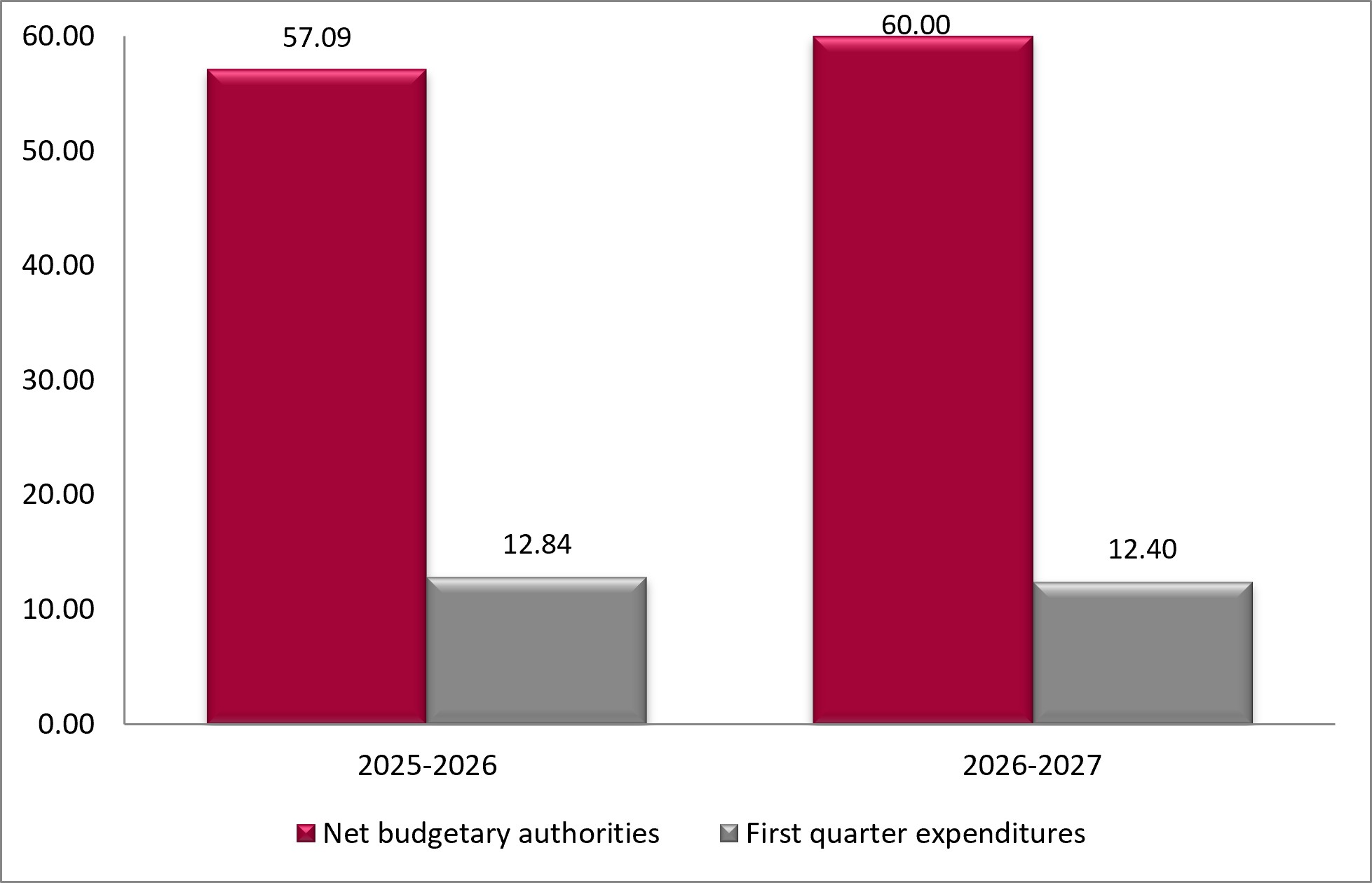
Text version of chart 1
The figure illustrates the Agency's net budgetary authorities and expenditures for the quarter ended June 30, 2025, for fiscal years 2025-2026 and 2026-2027 where budgetary authorities and expenditures, in millions of dollars, is shown on the vertical axis and time period, in fiscal years, is shown on the horizontal axis.
Time period: 2025-2026
Net budgetary authorities: 57.09 million dollars
First quarter expenditures: 12.84 million dollars
Time period: 2026-2027
Net budgetary authorities: 60 million dollars
First quarter expenditures: 12.40 million dollars
2.1 Significant changes to authorities
As illustrated in the Statement of Authorities and the Departmental Budgetary Expenditures by Standard Object tables at the end of this report, the Agency’s total authorities available for use increased by $2,908,249, or 5.1%, from $57,088,618 as of June 30, 2025, to $59,996,867 as of June 30, 2026. This increase in authorities available for use is primarily attributable to an increase in the Employee Benefit Plans (EBP) budgetary statutory authorities granted by Parliament.
2.2 Significant changes to expenditures
As illustrated in the Statement of Authorities and the Departmental Budgetary Expenditures by Standard Object tables at the end of this report, expenditures recorded to the end of the first quarter decreased by $433,869, or 3.4%, from the previous year, from $12,836,953 to $12,403,084 (see Table A: Variation in Departmental Expenditures by Standard Object).
Overall, the year-to-date expenditures at the end of the first quarter of 2026-2027 represent 20.7% of the annual planned expenditures, which is similar to the first quarter (22.5%) of 2025-2026.
| Variation in Q1 YTD expenditures between fiscal year 2025-2026 and 2026-2027 | |
|---|---|
| Personnel | (299,232) |
| Transportation and communications | 32,318 |
| Information | 592 |
| Professional and special services | (111,946) |
| Rentals | (55,949) |
| Repair and maintenance | 843 |
| Utilities, materials and supplies | 2,096 |
| Acquisition of machinery and equipment | (1,445) |
| Other subsidies and payments | (1,146) |
| Total net budgetary expenditures | (433,869) |
| Note: Explanations are provided for variances in excess of $100,000. | |
Professional and special services: In comparison to the previous fiscal year, expenditures decreased by $111,946, primarily due to timing differences in the receipt and processing of invoices related to data centre facilities services, as well as lower translation costs.
With respect to all other budgetary expenditures by Standard Object, overall expenditures are similar to those of the previous fiscal year. Any difference is primarily attributable to the period in which the purchases were settled.
3. Significant changes in relation to operations, personnel and programs
During the first quarter of 2026-2027, changes to the Agency's senior management were implemented. Alain Langlois was appointed Chair and Chief Executive Officer of the Agency, effective June 1, 2026, and Fred Gaspar was appointed Vice-Chair of the Agency, effective June 8, 2026.
4. Risks and uncertainties
Financial resilience: Given the unpredictability of workload (e.g. number of complaints) and as a result of on-going budgetary pressures and a high proportion of the Agency’s budget being temporary, there is a risk that sufficient funding sources may not be available to deliver on a timely manner activities and services. To mitigate this risk, the Agency has secured temporary funding through March 31, 2028, primarily to support the air passenger complaints program, and is exploring a full range of funding options, including cost recovery mechanisms. In addition, the Agency continually reviews and streamlines its business processes and procedures, while also adopting new technologies and tools to enhance efficiency.
Change management: The Agency is managing change driven by legal and policy shifts, coupled with the rapid emergence of transformative technologies. This dynamic environment requires that the Agency adapt its processes, systems, and workforce effectively. To mitigate the risks associated with the high rate of change and maintain agility, the Agency is reassessing its investment plans for technology and systems, as well as its strategies for employee development and training, with a view to further investing in and strengthening these areas. Additionally, the Agency is optimizing stakeholder engagement and external communications products.
The 2026 Spring Economic Update signaled the Government’s intention to undertake broader reforms to the air passenger protection regime and establish a third-party dispute resolution model for air passenger complaints. These changes will have significant implications for the Agency’s role, workforce, and operations, requiring careful planning, consultation, and change management to ensure a smooth transition and the continued effective delivery of its mandate.
Maintaining expertise: Sustaining a sufficient level of specialized technical professionals across critical transportation domains and accessibility may pose future challenges to the Agency’s ability to deliver on some of its key areas of responsibility. To mitigate these risks, the Agency is developing a talent pipeline, promoting knowledge sharing and development, and proactively planning for future workforce needs. At the same time, structured knowledge transfer and cross-training reduce reliance on individual employees, while strategic workforce planning helps anticipate skill gaps early so staffing risks can be addressed before they become critical.
Digital and technology: The Agency continues to manage several technology-related risks. Going into 2026-27, cybersecurity remains a priority, with challenges in retaining specialized resources and adapting to evolving threats. To mitigate these risks, the Agency is building partnerships and investing in modern, automated security solutions to strengthen resilience. Budget constraints and shifts in government policy may influence procurement processes and lead to delays; the Agency will focus on strengthening change management with Shared Services Canada to maintain continuity. The Agency is also addressing end-of-life technologies, such as unsupported website and intranet technologies, by prioritizing modernization and onboarding Canada.ca. Rapid AI adoption and data governance requirements are introducing privacy and compliance complexities, which are, and will be, managed through policy development, mandatory training, and process reviews. Finally, enterprise software delivery faces capacity challenges and varying readiness across business units. The Agency will continue to use its Digital Strategy to better align priorities and resources.
Approval by Senior Officials
Approved by:
Fred Gaspar acting for Alain Langlois
Chair
Signed on: August 24, 2026
Nadia Della Valle
Chief Financial Officer
Signed on: August 21, 2026
Statement of Authorities (unaudited)
| Total available for use for the year ending March 31, 2027* | Used during the quarter ended June 30, 2026 | Year to date used at quarter-end | |
|---|---|---|---|
| Vote 1 – Program expenditures | 50,914,458 | 11,272,350 | 11,272,350 |
| Budgetary statutory authorities − Employee Benefit Plans | 9,082,409 | 1,130,734 | 1,130,734 |
| Total authorities | 59,996,867 | 12,403,084 | 12,403,084 |
| Total available for use for the year ending March 31, 2026* | Used during the quarter ended June 30, 2025 | Year to date used at quarter-end | |
|---|---|---|---|
| Vote 1 – Program expenditures | 50,365,239 | 11,156,108 | 11,156,108 |
| Budgetary statutory authorities − Employee Benefit Plans | 6,723,379 | 1,680,845 | 1,680,845 |
| Total authorities | 57,088,618 | 12,836,953 | 12,836,953 |
Departmental Budgetary Expenditures by Standard Object (unaudited)
| Expenditures: | Planned expenditures for the year ending March 31, 2027 | Expended during the quarter ended June 30, 2026 | Year to date used at quarter-end |
|---|---|---|---|
| Personnel | 56,715,944 | 11,776,653 | 11,776,653 |
| Transportation and communications | 299,458 | 86,844 | 86,844 |
| Information | 422,942 | 196,302 | 196,302 |
| Professional and special services | 1,017,851 | 155,096 | 155,096 |
| Rentals | 1,125,569 | 177,918 | 177,918 |
| Repair and maintenance | 109,768 | 1,347 | 1,347 |
| Utilities, materials and supplies | 43,490 | 10,780 | 10,780 |
| Acquisition of machinery and equipment | 263,797 | 96 | 96 |
| Other subsidies and payments | (1,952) | (1,952) | (1,952) |
| Total net budgetary expenditures | 59,996,867 | 12,403,084 | 12,403,084 |
| Expenditures: | Planned expenditures for the year ending March 31, 2026 | Expended during the quarter ended June 30, 2025 | Year to date used at quarter-end |
|---|---|---|---|
| Personnel | 54,356,913 | 12,075,885 | 12,075,885 |
| Transportation and communications | 249,255 | 54,526 | 54,526 |
| Information | 352,037 | 195,710 | 195,710 |
| Professional and special services | 847,212 | 267,042 | 267,042 |
| Rentals | 936,870 | 233,867 | 233,867 |
| Repair and maintenance | 91,365 | 504 | 504 |
| Utilities, materials and supplies | 36,199 | 8,684 | 8,684 |
| Acquisition of machinery and equipment | 219,573 | 1,541 | 1,541 |
| Other subsidies and payments | (806) | (806) | (806) |
| Total net budgetary expenditures | 57,088,618 | 12,836,953 | 12,836,953 |
- Date modified: