
6. Air passenger protection
The CTA has a responsibility to provide consumer protection for air passengers. It does this through three primary activities:
- As per the section 86.11 (1) for the Act, “The CTA shall, after consulting with the Minister, make regulations in relation to flights to, from and within Canada, including connecting flights”;
- Promoting, monitoring, and enforcing compliance with the regulations; and
- Processing air passenger complaints and settling disputes between passengers and airlines.
The APPR, introduced in 2019, define the minimum obligations airlines have towards passengers in cases of flight disruptions. They cover flights to, from, and within Canada, including connecting flights.
In 2023, amendments were made to the Act to improve the clarity and consistency of the air passenger protection framework. The new legislative framework included eliminating the three flight disruption categories and requiring airlines to provide compensation for inconvenience to passengers when there is a flight disruption, unless there are exceptional circumstances, which the CTA would define by regulation. The changes also put the burden on airlines to prove the situation is an exceptional circumstance. The proposed amendments to the APPR were published in Canada Gazette I in December 2025. Amendments to the Act also required that the CTA change how it processes air travel complaints, resulting in a simpler, clearer, faster and more cost-effective process. Additionally, it proposed that the CTA recover from airlines some, or all, of the costs of dealing with air travel complaints through the air passenger complaint resolution process.
Looking ahead
The 2026 Spring Economic Update outlined the government’s intention to make further changes to Canada’s air passenger rights regime. The Minister of Transport announced that the government will:
- Eliminate the backlog of air passenger complaints by engaging a neutral, third-party dispute resolution organization;
- Increase the CTA’s enforcement powers by allowing fines for systemic violations of the APPR to be issued for up to $1M; and
- Develop a more effective regulatory regime (with responsibility for regulation-making in this area transferred from the CTA to the Minister).
Tabled on May 2, 2026, Bill C-31 proposes amendments to the Act to implement these changes – the CTA will work with Transport Canada officials to implement such changes as passed by Parliament.
6.1 Complaint resolution
The Complaints Resolution Office (CRO) processes air passenger complaints. It can order compensation, refunds, or reimbursements when airlines fail to meet their obligations.
The CRO was established in September 2023 as a result of legislative changes passed through the Budget Implementation Act, 2023, No. 1. 2023 in June 2023. In only three months, the completely redesigned CRO, a more straightforward, rapid, and cost-effective system, was launched. The model incorporates early eligibility screening, standardized workflows, and enhanced automation to support more timely resolution while maintaining procedural fairness. This work included:
- Designing the new complaints resolution process, including a new digitalized complaint management system;
- Developing and implementing a digital service model featuring an automated intake form as well as a secure eServices Portal for air carriers and passengers;
- Testing and validating portal functionality with five Canadian air carriers and onboarding 87 air carriers; and
- Recruiting and training its first cohort of 27 Resolution Officers (ROs), a completely new role in the organization (and subsequently recruiting and training a further two cohorts of ROs to bring the total number to 112).
Pre-CRO
Up until 2016, the CTA received roughly 850 air passenger complaints per year. This steadily grew over the following three years, culminating in a significant increase after the coming into force of the APPR, where in 2019-20, the number of cases received reached almost 20,000. Over the last four years, more than 40,000 complaints per year were received, a trend that is continuing.
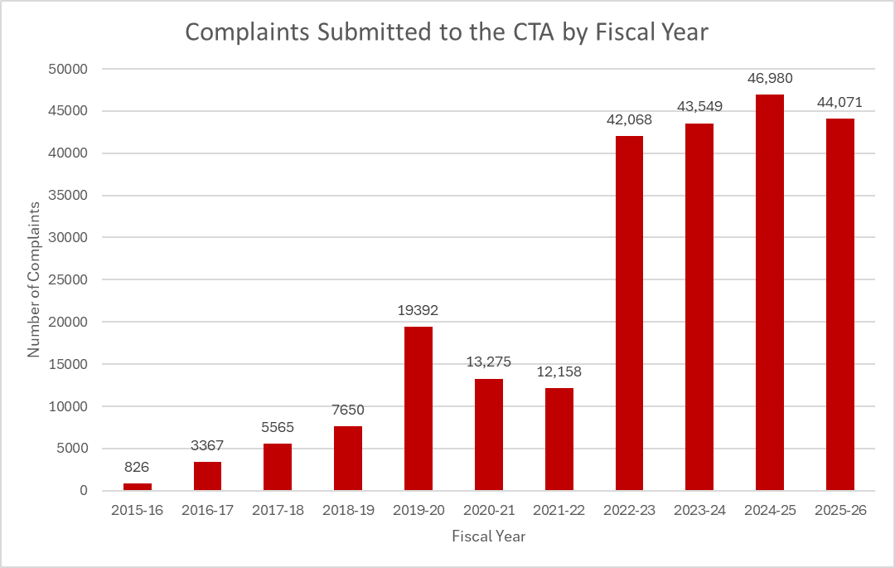
Text description - Complaints submitted to the CTA fiscal year
| Fiscal year | Number of complaints |
|---|---|
| 2015-16 | 826 |
| 2016-17 | 3,367 |
| 2017-18 | 5,565 |
| 2018-19 | 7,650 |
| 2019-20 | 19,392 |
| 2020-21 | 13,275 |
| 2021-22 | 12,158 |
| 2022-23 | 42,068 |
| 2023-24 | 43,549 |
| 2024-25 | 46,980 |
| 2025-26 | 44,071 |
As a result of these volumes, the backlog has now reached over 95,000 complaints. While the number of incoming complaints is not within the CTA’s control, the CTA is working to maximize the use of its available resources and increase its processing capacity.
A new model for complaints resolution
The CRO represents a transformation in the CTA’s handling of air passenger complaints. Decision-making authority is delegated to Complaints Resolution Officers (ROs), who are public servants employed by the CTA. The officers assess complaint eligibility, facilitate mediation (optional), and make final decisions.
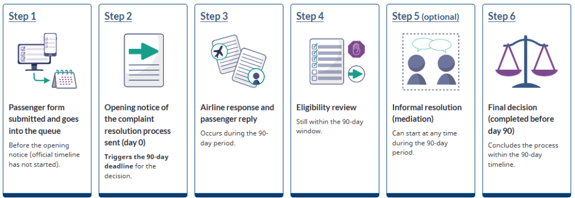
Text description - A new model for complaints resolution
- Step 1: Passenger form submitted and goes into the queue. Before the opening notice (official timeline has not started).
- Step 2: Opening notice of the complaint resolution process sent (day 0). Triggers the 90-day deadline for the decision.
- Step 3: Airline response and passenger reply. Occurs during the 90-day period.
- Step 4: Eligibility review. Still within the 90-day window.
- Step 5 (optional): Informal resolution (mediation). Can start at any time during the 90-day period.
- Step 6: Final decision (completed before day 90). Concludes the process within the 90-day timeline.
During its first full fiscal year of operation in 2024-2025, the CRO closed over 33,600 complaints, a 201% increase in comparison to the last full fiscal year preceding the creation of the CRO, when 11,158 cases were closed. This number also far exceeds the 22,400 complaints per year the CTA committed to close when it received temporary $75.9 million in additional funding over three years (2023-2026).
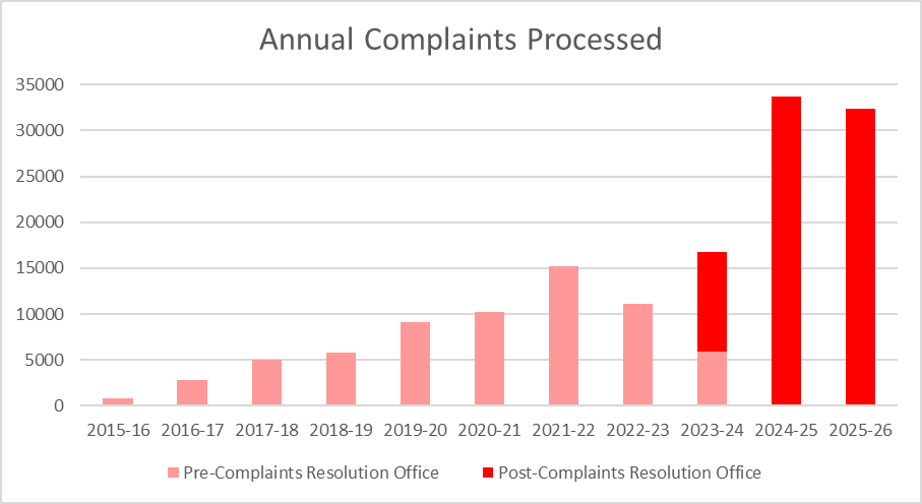
Text description - Annual complaints processed
| Fiscal year | Pre-complaints resolution office | Post-complaints resolution office |
|---|---|---|
| 2015-16 | 826 | 0 |
| 2016-17 | 2,752 | 0 |
| 2017-18 | 5,038 | 0 |
| 2018-19 | 5,798 | 0 |
| 2019-20 | 9,072 | 0 |
| 2020-21 | 10,157 | 0 |
| 2021-22 | 15,221 | 0 |
| 2022-23 | 11,104 | 0 |
| 2023-24 | 5,903 | 10,883 |
| 2024-25 | 0 | 33,696 |
| 2025-26 | 0 | 32,324 |
Challenges to complaints resolution
There are challenges that exist that the redesigned process must still contend with, largely as a result of the broader legislative and regulatory framework within which it must operate. The CRO administers a legally binding process, the outcome of which is subject to be challenged to the Federal Court through judicial review.
When making a decision, ROs must assess each individual complaint based on its own unique set of facts as provided by the passengers and the airline. This includes the nature of the flight disruption and the level of control of the airline (within control, within control but required by safety, outside control), the complexity of travel itineraries (as compensation depends on how late the passenger is at destination), and the involvement of single vs multiple airlines, among other factors.
The APPR are complex and set out key standards (e.g., “reasonableness,” “as soon as feasible,” “required for safety”). Flight disruptions (which account for the highest volume of cases received) typically involve multiple overlapping causes, and the APPR requires determining the most significant contributing factor for the disruption.
Evidence provided by airlines in their defense can be upwards of 80-100 pages and be variable, evolving, and sometimes incomplete. ROs must undertake a careful analysis of all the evidence submitted on the record in each case individually, prior to issuing a decision.
The legislation provides 90 days for the entire complaints process to be completed and for a final decision to be issued. Not considering the time complaints wait in the backlog, once a CTA RO begins working on a complaint, a decision is typically issued within 60 days on average.
The CTA is also making important investments in innovative technological solutions and in particular, artificial intelligence (AI). The leveraging of AI in the CRO represents a processing capacity multiplier that aligns the CTA with the new Government of Canada directives to integrate AI into existing workflows to reduce administrative tasks and improve overall service delivery for Canadians.
With the investments being made, the CTA estimates that it will be able to close over 45,000 complaints in next fiscal year.
Finally, while the CRO program has been designed to be scalable, allowing for additional ROs to be added and subtracted based on demand and available resources, there is a cost to staff turnover. Currently 40% of the CTA's budget is temporary, comprised primarily of the funding for ROs. This has contributed to a higher rate of turnover (staff seeking more stable employment) and requires greater allocation of time and resources to staffing, onboarding and training.
6.2 Current air passenger protection issues
Issue 1: APPR
Background information
The 2026 Spring Economic Update outlined the Government’s intention to transfer responsibility for regulation-making in this regard from the CTA to the Minister of Transport. Tabled on May 2, 2026, Bill C-31 proposes amendments to the Act to implement these changes.
Next steps
The CTA will continue to work to fulfill its legislated obligations including working with Transport Canada to transition the responsibility for developing the air passenger protection regulations should such provisions come in to force.
Issue 2: Backlog
Background information
Since the APPR were introduced in 2019, the CTA has experienced a consistent and significant increase in air travel complaints. Despite receiving supplemental temporary funding to address the growing volume of air travel complaints, the number of incoming complaints has exceeded projections. Consequently, the backlog of cases continues to grow despite the additional resources and process efficiencies implemented – the sustained high level of complaints submitted has resulted in the backlog standing at over 95,000 complaints at the end of fiscal year 2025-26.
Next steps
The CRO is continually reviewing and streamlining its business processes while also adopting new technologies and tools to continue to enhance efficiency, including:
- Enhancing the overall output, quality, and consistency of decisions;
- Implementing more AI-enabled tools, leveraging data science, and further enhancing automated tools to actively manage queued complaints; and
- Introducing new passenger tools to assess complaint eligibility before submission.
The CRO has established an ambitious closure target of 45,000 for fiscal year 2026-27.
Issue 3: Bill C-31: Elimination of complaints backlog
Background information
The 2026 Spring Economic Update outlined the Government’s intention to eliminate the backlog of air passenger complaints by engaging a neutral, third-party dispute resolution organization. Tabled on May 2, 2026, Bill C-31 proposes amendments to the Act to implement these changes.
Next steps
The CTA will work with Transport Canada to implement this initiative, per legislative changes made by Parliament.
Issue 4: Cost recovery
Background information
The 2023 modifications to the Act require the CTA to establish fees or charges to recover the costs for processing eligible air travel complaints, from airlines, under that new process.
In accordance with the Act, the CTA launched a public consultation from September 18 to November 4, 2024, on a fee of $790 for each eligible processed and closed air travel complaint. The CTA received a total of 83 written submissions: 30 from members of the public; 46 from airlines and other industry representatives; six from consumer advocacy organizations; and one from a territorial government, all of which were published on its website in December 2025.
Pursuant to Bill C‑31, tabled in Parliament on May 6, 2026, the Government is proposing amendments to the existing legislative framework. Under these changes, the current charge would become optional, and the authority to set the fee would be transferred to the Minister of Transport.
Next steps
The CTA will work with Transport Canada to implement any changes, per legislative changes made by Parliament.
- Date modified: