
8. Compliance and enforcement
The CTA regulates over 1,500 service providers in the air, rail, marine, and interprovincial bus sectors monitoring and enforcing compliance with approximately 700 accessibility, consumer protection and rail provisions enforceable by administrative monetary penalty. It uses a variety of tools to verify compliance with the relevant acts, regulations, orders, and authorizations. To serve the public interest, the approach used to resolve non-compliance is graduated, using informal (Cautionary notices) and formal enforcement measures (Formal warnings for accessibility provisions and Administrative monetary penalties).
8.1 Compliance and enforcement policy
The Compliance and Enforcement Policy applies to all CTA programs engaged in compliance monitoring and enforcement activities. It helps foster and ensure compliance by regulated parties with their legal obligations. Its guiding principles are:
- Results-based enforcement: choosing measures that best serve the public interest and consider the specific context and circumstances of each case;
- Data-driven and risk-informed decision-making: targeting resources where potential non-compliance may be present or will occur in the future;
- Fair, objective, consistent processes: including clear and well-communicated rules for inspections and investigations, applied impartially;
- Proactive and responsive enforcement; and
- Transparency: publishing the results of formal enforcement actions on the website.
The public interest is best served when regulated parties voluntarily comply with their legal obligations. To that end, the policy includes a continuum that first encourages compliance through outreach, education, and promotion. The CTA then monitors to confirm compliance, and if needed, uses enforcement measures to compel compliance, and conducts follow-up to confirm compliance is maintained.
Compliance continuum:
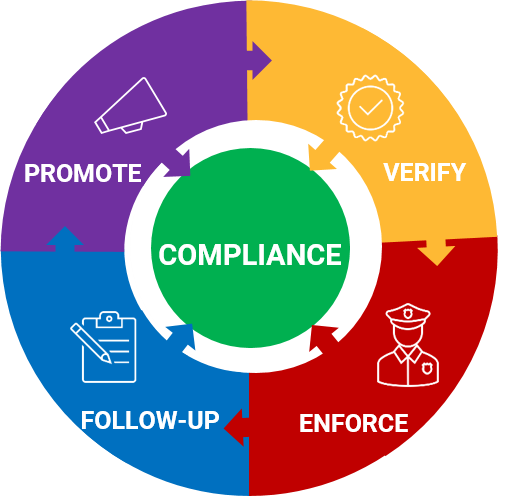
Designated Enforcement Officers (DEO) conduct the CTA’s compliance and enforcement activities, supported by Compliance Officers and informed by compliance strategies and advanced data analytics. DEOs have statutory powers of entry and inspection related to verifying compliance and can conduct administrative investigations and issue a Notice of Violation if they believe a violation has been committed.
8.2 Administrative monetary penalty framework
A Designated Enforcement Officer's (DEO) response to non-compliance escalates in severity depending upon the nature of the violation and the compliance history of the regulated entity. When a DEO believes that a regulated entity has committed a violation of the Act or regulations, or when a regulated entity has not complied with a CTA Order, they may issue a Notice of Violation (NoV) with Administrative Monetary Penalty (AMP).
Where a regulated entity contravenes a provision, requirement or condition that has been designated as one for which an AMP is available, the entity could be liable to an AMP of up to $25,000, or in cases of contravention of the ATPDR, they may be liable to an AMP of up to $250,000. The table below shows the number of NoVs with AMPs that the CTA has issued over the past five years:
| 2025-2026 | 2024-2025 | 2023-2024 | 2022-2023 | 2021-2022 | 2020-2021 | |
|---|---|---|---|---|---|---|
| NoV with AMP | 37 | 52 | 75 | 33 | 111 | 14 |
| Total amount of penalties in dollars | 1,429,350 | 1,586,610 | 1,343,930 | 725,380 | 253,975 | 849,700 |
The purpose of an AMP is to compel compliance, not to punish. The CTA assigns a severity rating to the violation ranging from Level A (considered to be strictly administrative) to Level D (the most serious), which determines the initial penalty amount. To establish the exact amount of the AMP, the DEO weighs and scores various gravity factors which determine whether a baseline penalty should be increased or decreased – these factors include history, preventing reoccurrence, cooperation, and characteristics of the violation.
Irrespective of the gravity factors mentioned above, if a regulated entity violates the same provision within a period of four years, each subsequent violation is doubled to the maximum amount specified for that provision.
NoVs with AMP can be reviewed before the Transportation Appeal Tribunal of Canada or addressed through a compliance agreement.
8.3 Current compliance and enforcement issues
Issue 1: Legislative changes introduced by the 2026 spring economic update
Background information
The 2026 Spring Economic Update outlined the government’s intention to make changes to Canada’s air passenger rights regime. The Minister of Transport also announced that the government will increase the CTA’s enforcement powers by allowing fines for systemic violations of the APPR to be issued for up to $1 million, a substantial increase from the current maximum of APPR provision-related penalties of $25,000. Tabled on May 2, 2026, Bill C-31 proposes amendments to the Act to implement these changes.
Next steps
The CTA will need to assign appropriate severity levels to the new provisions and realign its work plan activities with the new obligations of a potentially amended APPR. This will include ongoing proactive monitoring and analysis of complaints, flight data, media stories, enforcement actions, and other data sources to identify existing or emerging potential non-compliance issues, including specifically to ensure that compensation is only being denied in extraordinary circumstances.
Additionally, investigation and monetary penalty calculation practices will need to be modified to account for the new provisions and align with the new maximum penalties of $1 million, and opportunities to find investigatory efficiencies will be pursued where possible.
Issue 2: Amendments to the Canadian Transportation Agency Designated Provisions Regulations
Background information
When the Budget Implementation Act, 2023 was passed on June 22, 2023, modifying the Act, new obligations and provisions were created to develop the Complaint Resolution Office. To ensure all new obligations are enforceable by way of AMPs, an amendment of the Canadian Transportation Agency Designated Provisions Regulations is required.
Next steps
The CTA will need to ensure that all new enforceable provisions are assigned a severity level and analyzed to establish whether immediate proactive monitoring and/or verification is required.
Issue 3: Review of violations and penalties by the Transportation Appeal Tribunal of Canada
Background information
Notices of Violations with AMP issued by DEOs can be reviewed before the Transportation Appeal Tribunal of Canada (TATC). Recent reviews by TATC have resulted in some penalties being reduced or set aside.
Recent instances have included the following issues:
- In the review of an NoV issued under the APPR, the TATC found that differing reasonable interpretations of the categorization of flight disruptions should not be determined by the DEO but rather should be decided by decision makers such as the CRO and the TATC.
- In an accessibility-related matter, where CTA staff had interpreted the maximum penalty amount as being $250,000 pursuant to 177(3) of the Act, TATC interpreted the provision differently resulting in a significant reduction.
- In reviewing a railway noise and vibration violation, TATC offered a differing opinion on what are the requirements of a due diligence defense in the circumstances.
Next steps
The CTA will continue to monitor and analyze TATC decisions and, accordingly, consider adjustments in its enforcement approach.
- Date modified: