
1. Organizational overview
The CTA currently employs approximately 400 employees, with the Chair and CEO as the head of the organization. For the 2026-27 fiscal year, the CTA has a budget of $35.7 million in permanent funding, with an additional $26 million in temporary funding.
Branches and the Executive Committee
The CTA has five branches:
- Dispute resolution
- Determinations and compliance
- Analysis and outreach
- Legal and secretariat services
- Internal services
The heads of each branch report directly to the Chair and CEO and are members of the Executive committee.
1.1 Executive Committee (EC)
The Executive Committee (EC) is the CTA’s senior-level discussion and decision-making forum for all management-related matters. Weekly meetings between one to three hours in length are held, with extended meetings each quarter.
The Chair and CEO leads the EC, and its key roles are to:
- Establish strategic priorities;
- Approve and oversee implementation of major policies and initiatives;
- Share information on key meetings and developments;
- Advise the Chair and CEO on financial management and human resources;
- Establish performance expectations applicable across the Agency or across specific groups;
- Monitor organizational risks, opportunities, and results; and
- Foster core values and ethics, diversity, and the use of both official languages.
Executive Committee members:
- Chair and CEO (EC Chair)
- Vice-Chair: Vacant
- Chief of Staff: Sébastien Bergeron
- Chief Compliance Officer (Director General, Determinations and Compliance): Pascale Prince
- Chief Corporate Officer & Chief Financial Officer (Director General, Internal Services): Nadia Della Valle
- Chief Dispute Resolution Officer (Director General, Dispute Resolution): Ruth Dagenais
- Chief Strategy Officer (Director General, Analysis and Outreach): Lawrence Chow
- Senior General Counsel & Secretary: Valérie Lagacé
1.2 Budget
| Reference levels | |
|---|---|
| 2026-27 Main estimates | 35,702,168 |
| 2026-27 Supplementary estimates A (pending approval) | 24,294,699 |
| Total | 59,996,867 |
| In millions of dollars | 2022-23 | 2023-24 | 2024-25 | 2025-26 | 2026-27 | 2027-28 | 2028-29 | 2029-30 |
|---|---|---|---|---|---|---|---|---|
| Total permanent funding | 32.0 | 35.1 | 34.6 | 34.8 | 35.4 | 35.5 | 35.7 | 35.7 |
| Temporary funding | ||||||||
| Budget 2022 | 10.5 | |||||||
| Budget 2023 | 20.6 | 24.7 | 24.2 | |||||
| Budget 2025 | 24.3 | 24.2 | ||||||
| High speed rail | 0.2 | 0.3 | 0.3 | |||||
| Total temporary funding | 10.5 | 20.6 | 24.7 | 24.4 | 24.6 | 24.5 | 0.0 | 0.0 |
| Total available funds | 42.5 | 55.7 | 59.3 | 59.2 | 60.0 | 60.0 | 35.7 | 35.7 |
1.3 Human resources
The CTA currently employs approximately 400 employees, of which roughly 81% are indeterminate and 19% are temporary. There are currently 20 executives and three executive legal consultants. Most employees are based in the National Capital Region, with 73% reporting on-site and 27% teleworking, which includes regional-based Designated Enforcement Officers. The workforce size has remained stable year‑over‑year for the last three years.
In addition, the CTA remains focused on creating an organization that is diverse, inclusive, accessible, resilient, and that fosters a sense of belonging, while having a workforce that is representative of the Canadian population.
Currently, workforce representation of persons with disabilities, women, Indigenous Peoples, and visible minorities remains slightly below public service and labour‑market availability levels.
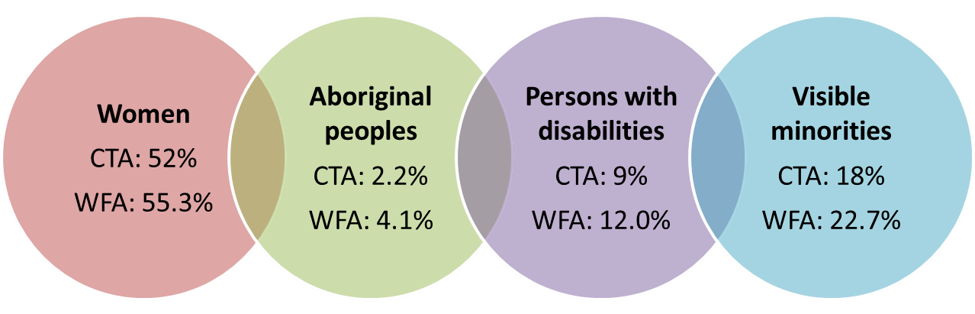
Text description - Human resources image
- Women: CTA: 52%, WFA: 55.3%
- Aboriginal peoples: CTA: 2.2%, WFA: 4.1%
- Persons with disabilities: CTA: 9%, WFA: 12.0%
- Visible minorities: CTA: 18%, WFA: 22.7%
- Date modified: