
1. Overview
1.1 Mandate
The Canadian Transportation Agency (CTA) is an independent regulator and quasi-judicial tribunal with the powers of a superior court reporting through the Minister of Transport to Parliament.
The Canada Transportation Act (the Act) is the CTA’s enabling legislation. The CTA has specific powers assigned to it under this Act:
- It is an economic regulator of modes of transportation under federal jurisdiction. It develops and applies ground rules that establish the rights and responsibilities of transportation service providers and their users, which level the playing field among competitors. These rules can be binding regulations, guidelines, or codes of practice;
- It is a tribunal that hears and resolves disputes like a court. It resolves disputes between transportation service providers and their clients or neighbours, using various tools from facilitation and mediation to arbitration and adjudication.
It has three key areas of responsibility:
- To help ensure that the national transportation system runs efficiently and smoothly in the interests of all Canadians: those who work and invest in it; the producers, shippers, travellers, and businesses who rely on it; and the communities where it operates.
- To provide consumer protection for air passengers.
- To protect the human rights of persons with disabilities to an accessible transportation network.
1.2 Organizational structure
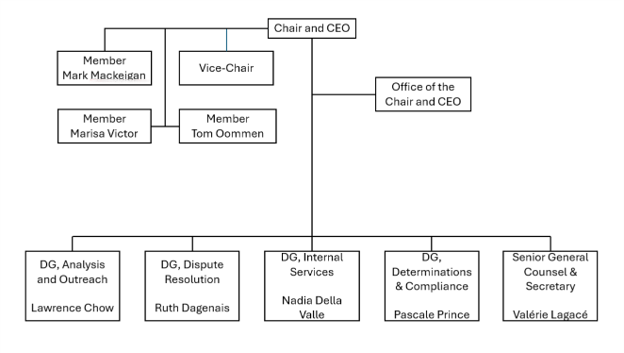
Text description - Organizational structure
- Chair and CEO
- Members:
- Member Mark MacKeigan
- Member Marisa Victor
- Vice-Chair
- Member Tom Oommen
- Office of the Chair and CEO
- Operational Executives:
- DG, Analysis and Outreach: Lawrence Chow
- DG, Dispute Resolution: Ruth Dagenais
- DG, Internal Services: Nadia Della Valle
- DG, Determinations & Compliance: Pascale Prince
- Senior General Counsel & Secretary: Valérie Lagacé
- Members:
Dispute Resolution Branch – Ruth Dagenais
The Dispute Resolution Branch (DRB), also known as the Air Transport Complaints Resolution Office (ATCRO), is responsible for managing and processing air passenger complaints.
Determinations and Compliance Branch – Pascale Prince
The Determinations and Compliance Branch (DCB) manages the authorities and licences issued by the CTA, and required by law, for transportation service providers to undertake or discontinue activities. It also monitors and enforces compliance with the various regulations under the CTA’s jurisdiction including the issuance of monetary penalties.
Analysis and Outreach Branch – Lawrence Chow
The Analysis and Outreach Branch (AOB) provides a broad, strategic focus and conducts research and analysis of issues, trends, and risks in the transportation system, provides advisory and analytical services within the CTA, and coordinates CTA-wide efforts on legislative and regulatory development.
Legal and Secretariat Services Branch – Valérie Lagacé
The Legal and Secretariat Services Branch (LSSB) provides legal advice on all CTA issues and cases and acts as the General Counsel and Secretary to the CTA. It also provides support for the development of procedures and regulations, and is responsible for registrar and secretariat services, and translation services.
Internal Services Branch – Nadia Della Valle
The Internal Services Branch (ISB) is responsible for the areas of finance, cost recovery, procurement and contracting, physical security, human resources, integrated management, information technology services, and information management services.
1.3 Duties of the Chair and CEO
The Governor-In-Council (GIC) designates one CTA Member as Chair and CEO of the CTA, who is responsible for supervising and directing the work of the Members and staff.
The Chair is accountable for all the CTA’s activities, including corporate matters. The Vice-Chair replaces the Chair and CEO during his or her absence.
Duties
The Chair and CEO:
- is the deputy head and most senior manager accountable for the CTA’s obligations under various statutes and central agencies’ policies and has delegation instruments to allow the CTA to select and appoint, or to revoke the appointment of, individuals it employs to fulfil its mandate, and holds the same powers as a department’s Deputy Minister under the Public Service Employment Act;
- ensures the efficient and effective use of resources allocated by Parliament, serving as the Accounting Officer under the Financial Administration Act;
- assumes the strategic direction of the CTA, including setting its strategic priorities;
- manages relationships with Minister, deputies, and senior officials of key stakeholders;
- assigns cases to, sets standards of conduct for, and oversees (without unduly interfering) the rigor and timeliness of the work of Members;
- participates in cases as a Member; and
- reports on the CTA's plans and results to Parliament through the Minister of Transport.
1.4 Members – Role, biographies, and code of conduct
Role
The CTA is comprised of up to five full-time members, including the Chair and Vice-Chair, and up to three temporary Members. All CTA members, as independent decision makers, are accountable for making quasi-judicial decisions and determinations on matters before the CTA. It is the role of the Chair to assign specific cases to Members.
Member biographies
Mark MacKeigan, Member

Mark MacKeigan began a four-year term as a Member of the CTA in May 2018 and was reappointed for a four-year term effective November 28, 2023. He is not entirely new to the CTA, having served previously as a Member from 2007 to 2014 and as legal counsel on specific files in a contract position during 1996.
He came from the St. Lawrence Seaway Management Corporation, the not-for-profit operator of the federal government's Seaway assets, where he was Chief Legal Officer and Corporate Secretary from 2014.
Mr. MacKeigan’s transportation law experience includes six years as senior legal counsel with the International Air Transport Association (IATA) in Montréal from 2001 to 2007, focusing on competition law, cargo services, aviation regulatory and public international law matters. From 1996 to 2000, he was legal counsel with NAV CANADA, the country's provider of civil air navigation services.
Mr. MacKeigan began his legal career in private practice in Toronto. After earning a Bachelor of Arts with highest honours in Political Science from Carleton University, he obtained his law degree from the University of Toronto and a Master of Laws from the Institute of Air and Space Law at McGill University. He also holds a postgraduate diploma in European Union Competition Law from King's College London.
Mr. MacKeigan is a member of the Bars of Ontario and the State of New York and is admitted as a solicitor in England and Wales.
Marisa Victor, Member

Marisa Victor began a four-year term as a Member of the CTA on January 9, 2024. She is a lawyer and adjudicator with expertise in civil litigation and administrative law.
Most recently, Ms. Victor was a Member of the Social Security Tribunal and a Member of the Condominium Authority Tribunal in Ontario. Previously, she was a Vice-Chair within Tribunals Ontario for six years. She has played a leadership role in improving access to justice and in transforming and modernizing several tribunals. A seasoned adjudicator, she has extensive experience in a wide variety of issues including regulatory compliance, consumer protection, professional responsibility, insurance claims, and human rights. As a civil litigator, Ms. Victor has worked on a range of complex, high-profile, and sensitive files. She has appeared before every level of court as well as numerous administrative tribunals. Prior to working in the private sector, she began her career as Legal Counsel to the Air India Inquiry.
Ms. Victor received her Bachelor of Fine Arts from York University, a Master’s in English from King’s College London, UK, and a joint Master’s in Environmental Studies and LLB from York University/Osgoode Hall Law School. She has been a member of the Law Society of Ontario since 2006. Ms. Victor identifies as Latinx and volunteers with various legal and arts organizations.
Tom Oommen, Member

Tom Oommen began a three-year term as a Member of the CTA on February 3, 2025.
He has previously served in several roles with the departments of National Defence, Global Affairs, Transport Canada, and Fisheries & Oceans in Valcartier, Ottawa, Paris, and Mexico City, with a focus on trade and transportation. Most recently, he was responsible for analysis and outreach at the CTA.
Mr. Oommen holds a Bachelor of Science from McGill University, a Bachelor of Engineering from the Université de Montréal, and a Master of Public Administration from Queen's University.
Annex A – Members code of conduct
A. Context
Mandate of the Agency
- The Canadian Transportation Agency (Agency) is an independent, quasi-judicial, expert tribunal and regulator which has, with respect to all matters necessary for the exercise of its jurisdiction, all the powers of a superior court.
- The Agency has three core mandates:
- Helping ensure that the national transportation system runs efficiently and smoothly in the interests of all Canadians: those who work and invest in it; the producers, shippers, travellers and businesses who rely on it; and the communities where it operates.
- Protecting the fundamental human right of persons with disabilities to an accessible transportation network.
- Providing consumer protection for air passengers.
Roles of the Agency’s Chair, Vice-Chair, Members, and staff
- The Agency is comprised of up to five regular Members appointed by the Governor in Council (GIC), including the Agency’s Chair and Vice-Chair, and up to three temporary Members appointed by the Minister of Transport from a roster approved by the GIC.
- Members make adjudicative decisions and regulatory determinations1. Their responsibilities in these regards cannot be delegated.
- The Chair, who has the dual role of Chief Executive Officer (CEO) and a Member, is responsible for overall leadership of the Agency. He or she sets the Agency’s strategic priorities, serves as its public voice, reports on its plans and results to Parliament through the Minister of Transport, and handles relations with Ministers, Parliamentarians, Deputy Ministers, and analogous bodies in other jurisdictions. He or she assigns cases to Members, supervises and directs their work, and chairs regular Members meetings. As CEO, he or she is the most senior manager of the public servants working in the organization, serves as Deputy Head and Accounting Officer with a broad range of related responsibilities under the Financial Administration Act and other statutes, and chairs the Executive Committee.
- The Vice-Chair, who is also a Member, sits on the Executive Committee and assumes the responsibilities of the Chair if the Chair is absent or incapacitated.
- Members other than the Chair and Vice-Chair do not have any managerial functions within the Agency.
- All Members are supported in the discharge of their decision-making duties by the Agency’s public servants, who are responsible for giving Members frank, impartial, evidence-based advice; fully implementing Members’ direction; and other tasks assigned to them by the Chair, their managers, or legislation.
B. General provisions
Purpose, guiding principles, and application of the Code
- This Code establishes the standards for the conduct of Members and applies to all regular and temporary Members. It supplements, and should be read in conjunction with, any applicable requirements and standards set out in the Canada Transportation Act; other legislation establishing ethical and conduct obligations, such as the Conflict of Interest Act; relevant regulations, policies, and guidelines; other relevant codes; and letters of appointment.
- The Code reflects:
- the Agency’s commitment to independent, impartial, fair, transparent, credible, and efficient decision making; and
- the Agency’s organizational values of respect for democracy, respect for people, integrity, stewardship, and excellence.
- Members shall:
- adhere to all elements of the Code and other applicable instruments listed in Appendix "A";
- uphold the highest ethical standards at all times;
- arrange their private affairs in a manner that ensures they have no conflicts of interest;
- conduct themselves with integrity, avoid impropriety or the appearance of impropriety, and eschew any action that could cast doubt on their ability to perform their duties with impartiality;
- not accept gifts, hospitality, or other advantages or benefits from any party that has an interest in matters handled by the Agency;
- recuse themselves from any proceeding where they know or reasonably should know that, in the making of the decision, they would be in a conflict of interest, or where their participation might create a reasonable apprehension of bias. In such case, they shall immediately inform the Chair and provide the reason for their recusal. Members are encouraged to seek the advice of the Chair and the Senior General Counsel when dealing with any situation where recusal is contemplated; and
- immediately inform the Chair if they become aware of a situation that may adversely affect the integrity or the credibility of the Agency, including possible non-compliance with the Code.
- The Chair is responsible for the administration of the Code and its interpretation. Members are accountable to the Chair for their compliance with the Code.
Members’ expertise and work arrangements
- Members have a responsibility to maintain the highest levels of professional competence and expertise required to fulfil their duties. Members are expected to pursue the development of knowledge and skills related to their work, including participation in training provided by the Agency.
- Regular, full-time Members must devote at least 37.5 hours per week to the performance of their duties during their term of appointment. If a regular Member is authorized by the Chair to continue to hear one or more matters before them upon expiry of their term, they shall only request remuneration for actual time worked during the period of continuation.
- When temporary Members are appointed on a full-time basis, they must devote at least 37.5 hours per week to the performance of their duties. When temporary Members are appointed on a part-time basis, they shall only request remuneration for actual time worked.
- Members’ designated workplace is at the Agency’s head office. They shall only work from home or other off-site locations with the prior written approval of the Chair.
C. Decision making
Impartiality
- Members must approach each case with an open mind and must be, and be seen to be, impartial and objective at all times.
Natural justice and fairness
- Members must respect the rules of natural justice and procedural fairness.
- Members must ensure that proceedings are conducted in a manner that is transparent, fair, and seen to be fair.
- Members shall render each decision on the merits of the case, based on the application of the relevant legislation and jurisprudence to the evidence presented during the proceeding.
- Members shall not be influenced by extraneous or improper considerations in their decision making. Members shall make their decisions free from the improper influence of any other person, institution, stakeholder or interest group, or political actor.
Preparation
- Members shall carefully review and consider relevant material – including applications, pleadings, briefing notes, and draft decisions – before attending case-related briefing sessions, meetings, or oral hearings.
Timeliness
- Members shall take all reasonable steps to ensure that proceedings progress in a timely fashion, avoiding unnecessary delays but always complying with the rules of natural justice and procedural fairness. Members shall render decisions as soon as possible after pleadings have closed and do their part to help ensure, to the greatest extent possible, that statutory timelines and internal service standards for the issuance of decisions are met.
Quality
- Members shall ensure that their decisions are written in a manner that is clear, logical, complete without being unnecessarily repetitive or lengthy, and consistent with any guidelines or standards established by the Agency regarding the quality and format of decisions.
Consistency
- Members shall, in fairness to the parties that appear before the Agency, consider principles well-established in previous decisions and shall provide well-articulated reasons if they decide to depart from those principles.
Respect for parties and participants
- Members shall conduct proceedings, including oral hearings, in a courteous and respectful manner, while ensuring that proceedings are orderly and efficient.
- Members shall conduct proceedings such that those who have cases before the Agency understand its procedures and practices and can participate meaningfully, whether or not they are represented by counsel.
- Members must be responsive to accessibility-related needs and implement reasonable accommodation measures to facilitate meaningful participation of parties and other participants with disabilities in Agency hearings.
- Members shall be responsive to diversity, gender, and other human rights considerations when conducting proceedings; for example, in the affirmation/swearing in of witnesses and the scheduling of oral hearings. Members shall avoid words, phrases, and actions that could be understood to manifest bias or prejudice based on factors such as disability, race, age, national origin, gender, religion, sexual orientation, or socio-economic status, and shall never draw inferences on a person’s credibility on the basis of such factors.
Case-related communications
- Members shall not communicate directly or indirectly with any party, counsel, witness, or other non-Agency participants appearing before them in a proceeding with respect to that proceeding, except in the presence of all parties or their counsel.
- Members shall not disclose information about a case or discuss any matter that has been or is in the process of being decided by them or the Agency, except as required in the performance of, and in the circumstances appropriate to, the formal conduct of their duties. Members shall refrain from discussing any case or Agency-related matter in public places.
D. Working relations and interactions
Relations with other Members
- Members shall foster civil, collegial relations with other Members.
- Members should have frank discussions and openly debate issues, while showing respect for one another’s expertise, opinions, and roles. Members shall not comment on another Member’s views, decisions, or conduct, except directly and privately to that Member themself, or to the Chair pursuant to subsection 11.g of this Code.
- Members assigned together to a Panel should strive to reach consensus decisions whenever possible, but respectfully agree to disagree and prepare a decision which includes a dissenting opinion where consensus cannot be achieved within a reasonable time period.
- Members should share their knowledge and expertise with other Members as requested and appropriate, without attempting to influence decisions in cases to which they are not assigned.
Relations with Agency staff
- Members shall at all times treat Agency staff with courtesy and be respectful of their views and recommendations, recognizing that staff are professional public servants who are required to offer their best advice to Members, who make the final decisions.
- Any concerns about staff performance should not be communicated directly to working-level employees but rather should be shared with the relevant Branch Head if the concerns are relatively minor and with the Chair if they are significant or systemic.
Interactions with non-Agency individuals and organizations
- Members shall not communicate with the news media on matters related to their role as Member. Enquiries from the media or members of the public shall be referred to the Chair’s Office.
- Members shall not communicate with politicians or officials of other federal departments and agencies, provincial or foreign governments, or international organizations regarding a matter that is, was, or could be before the Agency.
- Members shall not publicly express an opinion about any past, current, or potential cases or any other issue related to the work of the Agency, and shall refrain from comments or discussions in public or otherwise that may create a reasonable apprehension of bias.
- Members shall not disclose or make known, either publicly or privately, any information of a confidential nature that was obtained in their capacity as a Member.
- Members shall not use their position or the Agency’s resources (e.g., an Agency email account or letterhead) for personal gain.
E. Outside activities
- Members shall not accept invitations to attend social events such as receptions or dinners with stakeholder representatives or with persons who are, or may become, a party, counsel, witness, or other non-Agency participants in an Agency proceeding, except in rare instances where there is a compelling justification and the Chair provides prior written approval.
- Members may take part in other outside activities that are not incompatible with their official duties and responsibilities and do not call into question their ability to perform their duties objectively, with the prior written approval of the Chair. Such activities may include participation in conferences and training seminars, speeches, teaching assignments, and volunteering.
- Requests for the Chair’s approval of participation in social events or other outside activities must be made in writing at least two weeks before those events or activities begin, and must fully disclose all relevant details. Members are also responsible for obtaining any other approval required by applicable legislation, guidelines, codes, or other instruments.
- Notwithstanding the foregoing, the Chair may, from time to time, confer with stakeholder representatives, counsel, or other parties in their role as the head of a regulatory organization, to discuss matters unrelated to any specific dispute or determination.
F. Social media
- Members are free to use social media, but they must use good judgment if they decide to follow people and organizations or post comments where the public can see them. Members must understand that what they do on social media is in the public domain.
- Members must refrain from using social media to talk about or comment on the Agency. Members must not comment on cases before the Agency on social media.
G. Affirmation
- Members shall review and affirm their commitment to and compliance with the Code upon initial appointment and every year thereafter on or near the anniversary of their appointment.
Appendix A
(Paragraph 11 – Applicable codes)
1.5 Independence and impartiality
Like other administrative agencies, the CTA is part of the executive branch of government and its purpose is to implement government policy. It has a duty to be independent and impartial to the extent determined by the laws voted by Parliament.
In its role as a regulator and regulations-maker, the CTA must sometimes engage with government officials, the industries it regulates, and consumer and disability rights organizations. Engagement also allows the CTA to stay informed and further its expertise in transportation matters, supporting its ability to competently advance its mandate.
Certain safeguards in the Act ensure the CTA is not controlled or inappropriately influenced by the government or others in its regulatory or any other role. The CTA has also adopted additional safeguards to maintain its independence and impartiality. Key safeguards include:
- rules regarding the selection, appointment, and tenure of members;
- conflict of interest prohibitions under the Act and other statutes;
- code of conduct and values and ethics requirements for members and employees, which are also embedded in various CTA practices;
- CTA rules, guidelines, and practices for complaint and determination cases, which ensure a fair process; and
- CTA engagement practices that include never discussing the merits of specific cases.
The CTA has an independence statement available on its website. It explains in detail the concepts of independence and impartiality, their place in common law and natural justice, and the safeguards that preserve them at the CTA. The statement also provides more information about the provisions in the Act, the government policies, and the court decisions that have informed the principles of independence and impartiality.
1.6 Values and ethics
Staff and Members at the CTA are bound by the Values and Ethics Code for the Public Sector. In addition, the CTA has two codes, one for staff and one for Members, which outline the values and behaviours the CTA expects its public servants to demonstrate as they carry out their professional duties.
Members
As Governor-in-Council appointees, Members follow a separate CTA code. The CTA Members Code of Conduct applies to all regular and temporary Members. It stresses that Members must always uphold the highest ethical standards, including in their interactions with staff and others and in their outside activities. The code explains in full the principles Members must apply when making decisions, which are, in brief:
- Impartiality
- Natural justice and fairness
- Preparation
- Timeliness
- Quality
- Consistency
- Respect for parties and participants
- (Maintaining appropriate) Case-related communications
Members should read their Code in conjunction with other, relevant ethical and conduct standards. This includes those set out in the Act or other legislation, policies, guidelines, other relevant codes, and their letter of appointment.
Staff
The Code of Values and Ethics for the Canadian Transportation Agency applies to every person employed by the CTA, including staff and managers, terms, casuals, students, and secondees. It sets out a connected set of principles that should be integrated into CTA actions, decisions, policies, processes, and systems. In brief, these are:
- Respect for democracy
- Respect for people
- Integrity
- Stewardship
- Excellence
As the Chair, you are responsible for overseeing the implementation of the Code, fostering a culture of value and ethics, and related activities. You are supported in this by the Executive Committee, which monitors the application of the Code, and by managers, who work to integrate the principles into organizational practices.
1.7 Evolution of CTA's mandate
Origins of the CTA
The CTA began as the Board of Railway Commissioners in 1904. The Board had the full powers of a superior court to hear all railway complaints, and its decisions were binding. It had regulatory powers over the construction, operation, and safety of railways (except those owned by the government), and set various freight rates and charges.
Key expansions of the mandate
The CTA mandate expanded at several key points during the twentieth century.
- 1938: The Board of Railway Commissioners became the Board of Transport Commissioners. In addition to rail powers, this board had new authorities over air and water transport, limited mainly to certain licensing and rates issues.
- 1967: The Board became the Canadian Transport Commission. It handled five modes of transportation – rail, air, water, motor vehicle, and commodity pipeline (except for oil products).
- 1988: Under the new National Transportation Act (1987), the Commission became the National Transportation Agency (NTA). The NTA served to implement a new National Transportation Policy enshrined in the Act (discussed in Section 3 of this binder) and had powers that included:
- granting transportation licences, reviewing public complaints, and helping resolve disputes between shippers and transportation firms;
- holding public hearings and settling disputes between shippers and carriers, but only in response to specific complaints or at the government’s request;
- providing mediation and final offer arbitration services on request; and
- monitoring major company mergers and acquisitions in all modes of transportation (a responsibility that is now largely with Transport Canada).
- 1992: The needs of travellers with disabilities became an integral part of the NTA’s jurisdiction, as the above Act was amended to include the words “accessible” and “persons with disabilities” in its declaratory clause.
- 1996: The new Canada Transportation Act renamed the National Transportation Agency as the Canadian Transportation Agency.
A twenty-first century agency
In this century, the National Transportation Policy has remained largely intact, and the CTA continues to implement it in its dual role as a quasi-judicial tribunal and an economic regulator. Responsibilities continue to include issuing licences to air and railway companies; resolving disputes over various air, rail and marine rate and service matters; and removing undue obstacles to the mobility of travellers with disabilities.
That said, additional key changes have further refined the CTA’s mandate, as follows.
- 2000: The CTA stopped setting maximum rates for moving Western grain by rail and introduced the Maximum Revenue Entitlement that continues to this day. Also in 2000, an Air Travel Complaints Commissioner position was created within the Agency to review and attempt to resolve complaints of airline customers.
- 2007: The CTA formally began using mediation to resolve complaints, having tested and proved it as a cost-effective, efficient alternative to the more formal and court-like adjudication process. However, the CTA mandate allowed it to resolve complaints with mediation on a case-by-case basis only.
- 2016: The CTA initiated a new approach to outreach and engagement, making industry stakeholders and travellers aware of their transportation-related rights and responsibilities, and how the CTA could help.
- 2017: Amendments to the Act empowered the CTA to, among other things, make new air passenger rights regulations.
- 2019: The CTA completed a three-year review and update of all its regulations and related guidelines. This resulted in key new regulations being registered that year, including the Air Passenger Protection Regulations (APPR) and Accessible Transportation for Persons with Disabilities Regulations (ATPDR). Various existing regulations were modernized through amendments (as discussed in Section 3).
- 2021: The ATPDR was amended, clarifying technical requirements.
- 2022: The APPR was amended, including to protect air passenger rights through the post-pandemic realities of travel.
- 2023: The CTA established a Complaints Resolution Office to address the backlog of air passenger complaints stemming from the above pandemic and post-pandemic developments.
- Date modified: